

Nonprofit events often need media attention without the budgets available to commercial brands. Effective coverage depends on news value, audience relevance, timing, media preparation, and efficient distribution. A small budget works when each activity has a defined purpose and supports the event’s central story.
For UK charities and nonprofit organisations, the strongest opportunities often come from local relevance, community impact, human-interest elements, measurable outcomes, and timely issues. These factors give journalists a clear editorial reason to cover an event.
Organisations exploring the educational foundations of:
Nonprofit event news coverage on small budgets can first understand what makes nonprofit events relevant to journalists. The next step is selecting a practical coverage approach that matches available resources.
What makes a nonprofit event newsworthy?
Nonprofit events gain affordable news coverage by focusing on a public-interest story, preparing concise media materials, targeting relevant UK publications, and using efficient distribution methods. Campaigns connect the event to measurable community impact, timely issues, local relevance, or recognisable participants.
Newsworthiness is the foundation of event coverage. Journalists do not cover an event simply because an organisation has scheduled it. They need a story with relevance to their audience.
A charity fundraising event becomes stronger when it includes a measurable fundraising target, a community challenge, a notable participant, or a significant beneficiary outcome. For example, a Manchester charity launching a £100,000 campaign to support local families has a clearer local news angle than a generic fundraising dinner.
Which news angles work for nonprofit events?
Common angles include:
- A major fundraising milestone.
- A new community initiative.
- A public awareness campaign.
- A local employment or skills programme.
- A partnership with a recognised organisation.
- A prominent speaker or participant.
- A measurable community outcome.
- A response to a current social issue.
The angle needs to appear early in the headline and opening paragraph. Journalists need to understand the story before reading detailed event information.
How can nonprofits prepare an affordable media strategy?
Nonprofit organisers can build coverage efficiently by defining the news angle, creating a media-ready release, selecting publications, preparing supporting assets, pitching targeted journalists, distributing the announcement, and tracking results. Each stage reduces wasted effort and directs budget toward relevant audiences.
A media strategy establishes what the organisation wants coverage to achieve. The objective can involve awareness, attendance, fundraising, stakeholder engagement, volunteer recruitment, or public education.
The strategy also defines the target media audience. A regional charity event requires a different media list from a national conference on healthcare policy.
How does audience targeting control costs?
Targeting prevents unnecessary outreach. A nonprofit can prioritise publications whose readers match the event’s purpose.
For example, a Birmingham youth employment event can target Birmingham-based news outlets, West Midlands business publications, education media, community publications, and relevant trade titles. A national distribution campaign adds value when the event has wider policy or sector significance.
The media list needs accurate publication names, editorial contacts, geographic coverage, subject relevance, and submission requirements. A smaller, relevant list often creates a more efficient campaign than an oversized database with little editorial alignment.
What should a nonprofit event media package include?
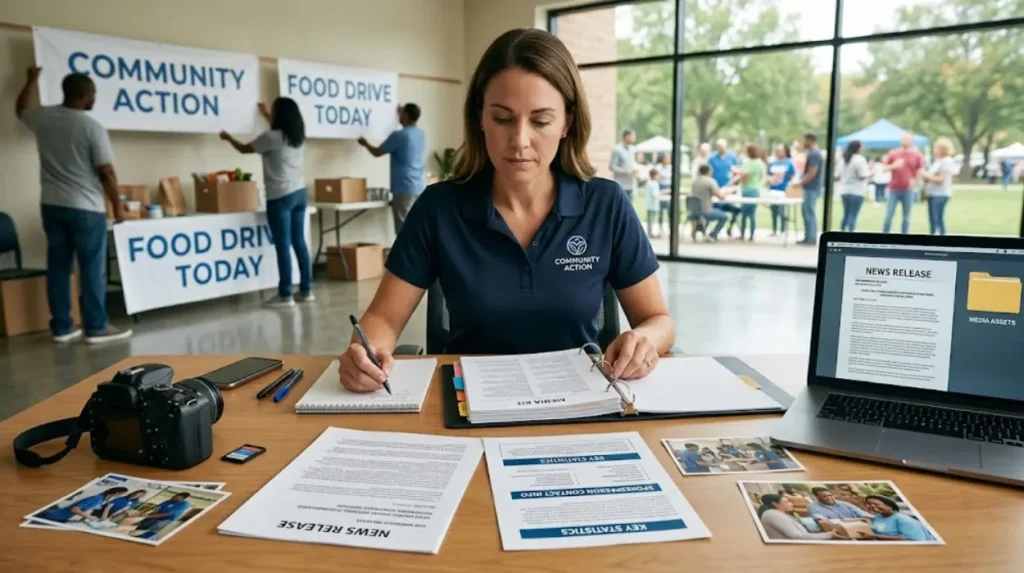
An effective nonprofit media package includes a news release, headline, event details, spokesperson information, verified statistics, photographs, contact details, and supporting links. These components give journalists facts and reduce production time when an event has genuine public-interest relevance for audiences.
A media package gives journalists the information required to assess and develop a story. It also reduces repeated requests for basic facts.
What information belongs in the press release?
A strong nonprofit event release normally includes:
- A news-focused headline.
- A concise opening paragraph.
- Event date, location, and purpose.
- The organisation’s role.
- Verified statistics or campaign figures.
- A spokesperson quotation.
- Information about beneficiaries or community impact.
- Relevant partner information.
- A clear media contact.
- Supporting links.
The release needs factual accuracy. Names, dates, figures, job titles, locations, and organisation names require verification before distribution.
Which visual assets improve coverage?
High-quality photographs give publications usable material. Relevant images include event speakers, volunteers, beneficiaries where appropriate, community activities, campaign launches, and distinctive event moments.
A charity running a London food donation event can provide photographs showing volunteers preparing food parcels, the campaign team at work, and the event location. Captions need to identify people and explain what the image shows.
Which media channels offer the best value for a small nonprofit budget?
Small budgets benefit from targeted distribution because relevance improves efficiency. Nonprofits can prioritise local newspapers, regional publications, sector media, community outlets, and titles instead of paying for exposure without alignment. Coverage quality depends on news value, accuracy, timing, and fit.
Media channels serve different audiences. Local publications are valuable for events with geographic relevance. Trade publications work well for sector-specific announcements. Community media reaches audiences connected to local causes and initiatives.
Should nonprofits prioritise local or national media?
The answer depends on the story.
A community fundraiser in Leeds has strong relevance for Yorkshire publications and local news desks. A UK-wide research report released during a national policy debate has broader relevance.
National coverage becomes more realistic when the story contains a national issue, significant statistic, recognised figure, unusual result, or wider public-interest consequence.
What role does sector media play?
Sector media provides access to specialised audiences. Examples include healthcare publications for medical charities, education publications for youth organisations, and business media for social-enterprise initiatives.
This type of coverage helps nonprofits communicate directly with stakeholders who understand the subject and can act on the information.
How does affordable distribution work for nonprofit event coverage?
Nonprofit event distribution combines direct journalist outreach, targeted media lists, press release distribution, owned channels, and supporting content. The most efficient approach assigns each activity a clear purpose and prioritises outlets where the event has genuine editorial relevance.
Distribution does not need to rely on one channel. A nonprofit can combine direct outreach with broader publication targeting.
Direct pitching works when the story is highly relevant to a specific journalist or publication. Wider distribution provides a structured way to place the announcement before multiple relevant outlets.
Owned channels also support the campaign. A nonprofit website can publish the release, while LinkedIn, email newsletters, event pages, and partner channels extend the announcement to existing audiences.
When does wider distribution make sense?
Wider distribution becomes useful when the announcement has relevance across multiple regions or sectors.
For example, a UK charity launching a nationwide volunteering initiative has a broader media audience than a single-location fundraising event. Distribution can then include regional publications, national news outlets, nonprofit media, and specialist sector publications.
Organisations assessing practical options can explore:
Affordable nonprofit event coverage to understand how multi-publication distribution fits a controlled campaign budget.
What benefits does news coverage provide after the event?
Event coverage helps nonprofits extend awareness beyond attendees, document community activity, strengthen credibility, support fundraising communication, and create reusable evidence of impact. Published stories also provide assets for websites, newsletters, stakeholder reports, social channels, grant communications, and future outreach campaigns.
Media coverage extends the lifespan of an event. Attendance ends on the event date, but published coverage remains available through publication websites and search results.
Coverage also creates third-party evidence that an organisation is active and producing measurable community outcomes.
How can nonprofits reuse published coverage?
Published articles can support:
- Website news sections.
- Annual reports.
- Donor communications.
- Grant applications.
- Partner updates.
- Email newsletters.
- Social media posts.
- Fundraising campaigns.
- Future media pitches.
A published article also provides a factual record of the event. Organisations can maintain a coverage archive containing article URLs, publication names, publication dates, screenshots, and relevant performance data.
How does coverage support future campaigns?
Previous coverage provides evidence for future outreach. Journalists can see the organisation’s previous announcements and understand its areas of activity.
A consistent record of credible coverage also helps nonprofit teams identify which topics receive attention. The organisation can then refine future announcements around proven editorial interests.
How can nonprofits measure whether event coverage was worth the budget?
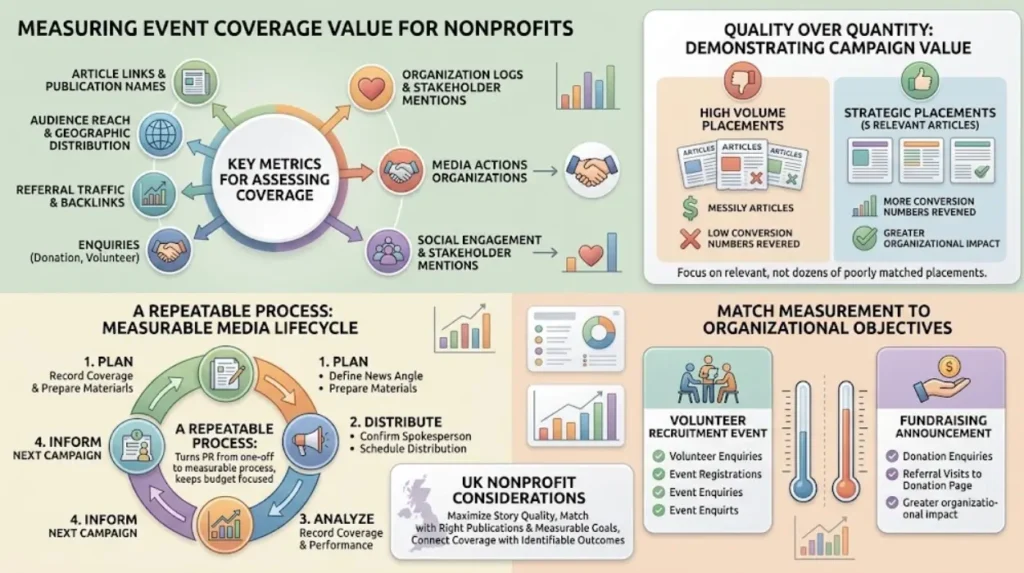
Nonprofits can assess coverage by tracking publication names, article links, audience, referral traffic, backlinks, enquiries, social engagement, stakeholder mentions, and campaign conversions. A reporting framework connects media activity with organisational objectives and identifies outlets and story angles that deliver results.
Measurement needs to match the original campaign objective. A fundraising announcement requires different metrics from a volunteer recruitment event.
Which metrics matter most?
Useful measures include:
- Number of published articles.
- Number of relevant publications.
- Geographic distribution.
- Referral visits.
- Backlinks.
- Event registrations.
- Donation enquiries.
- Volunteer enquiries.
- Social engagement.
- Stakeholder mentions.
Publication volume alone does not demonstrate campaign value. Five relevant articles can provide stronger strategic value than dozens of poorly matched placements.
For example, a charity promoting a London employment programme can compare media referral traffic with registrations generated after publication. This connects coverage with an identifiable organisational outcome.
How should nonprofits build a repeatable process?
A repeatable process starts before the event. The organisation defines the news angle, creates the media materials, prepares the publication list, confirms spokesperson availability, and schedules distribution.
After publication, the team records coverage and performance. The results inform the next campaign.
Explore More Expert Insights:
How Property Launch Coverage Reaches UK Real Estate Readers
How Award Winners Get Covered Across 15 UK News Sites
This approach turns nonprofit event PR from a one-off activity into a measurable media process. It also keeps limited budgets focused on story quality, relevant publications, accurate materials, and outcomes that support the organisation’s objectives.
For UK nonprofits, affordable event coverage is therefore less about maximising the number of media contacts and more about matching a strong public-interest story with the right publications, distribution method, timing, and measurable campaign goal.



