Events create concentrated moments of public attention. Professional news coverage turns those moments into documented stories distributed through credible media channels. It records announcements, speakers, business developments, partnerships, launches, and audience activity in a format that audiences can discover after the event ends.
For event organisers, businesses, associations, and institutions across the United Kingdom, news coverage provides a structured way to communicate what happened and why it matters. It differs from social media posts, event listings, and promotional content because news coverage follows editorial conventions and presents information as a reportable event.
Understanding the role of event news coverage helps organisers plan communications before, during, and after an event. The following seven reasons explain its value.
Why does professional news coverage make an event more visible?
Professional news coverage increases event visibility by converting important event developments into searchable news content that reaches audiences beyond attendees, including customers, industry professionals, journalists, partners, investors, and people researching the organisation later.
An event has a limited physical or digital attendance window. News coverage extends its information lifespan. A conference held in Manchester, for example, ends after its scheduled sessions, but coverage of its keynote announcement or industry findings remains accessible through search and media platforms.
Professional coverage also separates event information from ordinary promotional posts. A published news article provides a structured account of the event, including relevant names, dates, locations, announcements, and outcomes.
What information becomes visible?
Common newsworthy elements include:
- Product or service launches
- Corporate announcements
- New partnerships
- Expert presentations
- Industry research
- Awards and recognitions
- Investment announcements
- Community initiatives
- Major attendance figures
- Business milestones
This structure gives search engines and readers clear information about the event and its significance.
How does event coverage reach people who did not attend?
Professional event coverage communicates key developments to non-attendees by publishing factual reports that summarise important announcements, discussions, speakers, partnerships, launches, and outcomes for audiences outside the original event environment.
Attendance represents only one audience segment. A UK business event can attract hundreds of people while reaching thousands of relevant professionals through subsequent media reporting.
A technology conference in London, for example, can generate coverage about a new software launch. The resulting article reaches people who were not present but search for the company, product category, speaker, or announcement.
This wider reach matters because event audiences often include several groups.
Who can discover event coverage?
Relevant audiences include:
- Potential customers researching a business.
- Industry professionals following market developments.
- Journalists monitoring emerging stories.
- Investors researching company activity.
- Business partners evaluating organisations.
- Job candidates researching employers.
- Existing customers looking for recent developments.
Professional coverage therefore expands the communication audience beyond ticket holders and registered participants.
For organisations planning a broader media strategy, understanding:
Event coverage packages also helps clarify how coverage can extend across multiple publications.
Why does professional news coverage create a lasting record of an event?
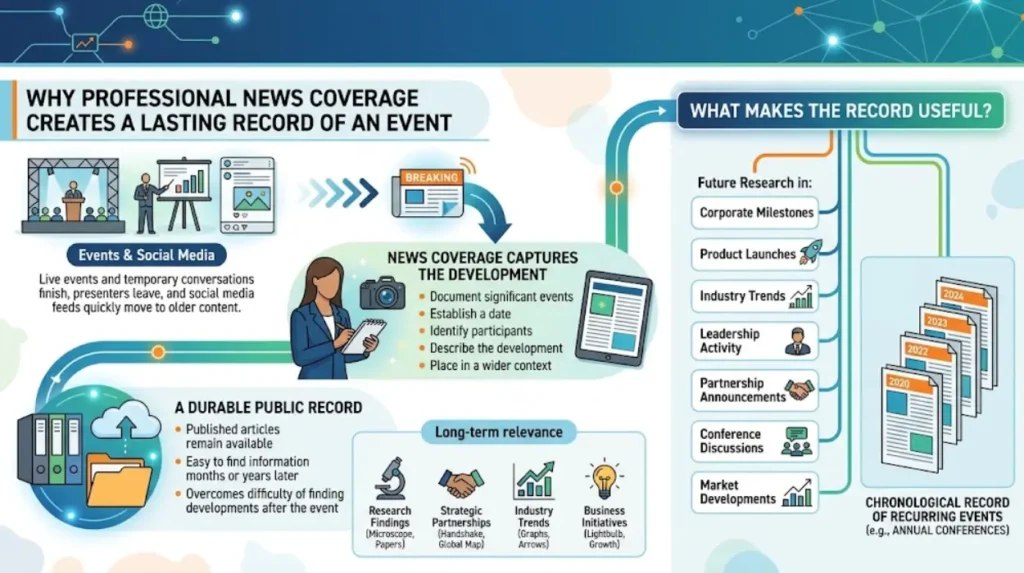
Professional news coverage creates a lasting public record by documenting significant event developments in published articles that remain available after the venue closes, presentations finish, and social media conversations move into older content.
Events often contain information with long-term relevance. A keynote introduces new research. A company announces a strategic partnership. An association publishes industry findings. A business launches a new initiative.
Without formal coverage, these developments can become difficult to find after the event.
News articles provide durable documentation. They establish a date, identify participants, describe the development, and place the event within a wider business or industry context.
What makes the record useful?
A published article can support future research into:
- Corporate milestones
- Product launches
- Industry trends
- Leadership activity
- Partnership announcements
- Conference discussions
- Market developments
The record also provides a reference point for people who encounter the organisation months or years later.
This is particularly relevant for annual conferences and recurring events. Coverage from each edition creates a chronological record of announcements, speakers, themes, and developments.
How does news coverage strengthen an event’s search visibility?
News coverage strengthens search visibility by creating indexed pages containing relevant event names, organisations, speakers, locations, topics, and announcements that search engines can associate with the event and its wider subject area.
Search visibility depends on how clearly information is presented and connected to identifiable entities. An event article can contain multiple relevant signals within one page.
For example, coverage of a Birmingham manufacturing conference can reference the event name, venue, manufacturing sector, keynote speaker, participating company, product announcement, and regional location.
These entities provide contextual information for search systems.
What search elements can event coverage support?
Relevant elements include:
- Event name searches
- Organisation name searches
- Speaker name searches
- Topic-related searches
- Location-based searches
- Industry searches
- Announcement searches
A well-structured article also gives readers a direct source to consult when searching for information about an event.
This becomes increasingly important as search behaviour expands beyond simple keywords. Search systems interpret relationships between entities, topics, locations, dates, and events.
How can event coverage support credibility?
Professional news coverage supports credibility by presenting event developments within a recognisable journalistic format that identifies organisations, people, announcements, dates, and relevant context instead of relying only on self-published promotional statements.
Credibility comes from clear information and transparent attribution. A professional article identifies who made an announcement, where it happened, and what the announcement means.
Consider a healthcare conference announcing a new research collaboration. A factual report can identify the participating organisations, describe the collaboration, name relevant speakers, and explain the announcement.
That information gives external audiences a clearer understanding of the development.
What improves the credibility of an event story?
Strong event reporting normally includes:
- Accurate organisation names
- Correct speaker names and titles
- Verified event dates
- Clear locations
- Specific announcements
- Relevant quotations
- Supporting facts
- Appropriate industry context
Accuracy is particularly important for business events. Incorrect names, dates, statistics, or organisational details reduce the usefulness of coverage.
Professional reporting therefore depends on information quality as much as publication reach.
Why does event coverage extend the value of event content?
Event coverage extends content value by transforming presentations, announcements, interviews, research findings, and business developments into published stories that remain discoverable beyond the original programme, social posts, livestream, or presentation schedule.
Events already generate substantial information. Speakers prepare presentations. Organisations announce developments. Exhibitors demonstrate products. Panels discuss industry issues.
Professional coverage captures selected information in a format designed for wider consumption.
A fintech event, for example, can produce coverage from a regulatory discussion, a product announcement, and an executive interview. Each development addresses a different information need.
Which event content has news value?
Common examples include:
- New research findings
- Business expansions
- Strategic partnerships
- New product announcements
- Executive appointments
- Awards
- Investment announcements
- Industry predictions
- Regulatory discussions
- Community programmes
This process gives event organisers more durable content assets without changing the underlying facts of the event.
It also creates opportunities for audiences to encounter the same development through different information journeys. One person searches for the event. Another searches for the company. Another searches for the speaker or announcement.
How does professional coverage help demonstrate an event’s wider importance?
Professional coverage demonstrates wider event importance by connecting individual event activities with broader business, industry, regional, or community developments that matter to audiences beyond the people directly involved in the event.
An event becomes more newsworthy when its content connects to a larger subject.
A Glasgow business conference discussing employment growth, for example, has relevance beyond the attendees if the discussion includes specific employment figures, new investment, or business expansion.
The same principle applies to cultural, educational, sporting, technology, healthcare, and corporate events.
What creates wider relevance?
Three elements commonly increase relevance:
Specific development: The article identifies what actually happened.
Affected audience: The report explains who the development concerns.
Wider context: The article connects the development with an industry, regional, economic, technological, or social issue.
This approach keeps event coverage informative rather than purely promotional.
Readers gain a reason to understand the event even when they did not attend it.
Explore More Expert Insights:
What Expo News Coverage Delivers for UK Brands
How Glasgow Events Secure UK-Wide News Coverage
When is professional event news coverage most useful?
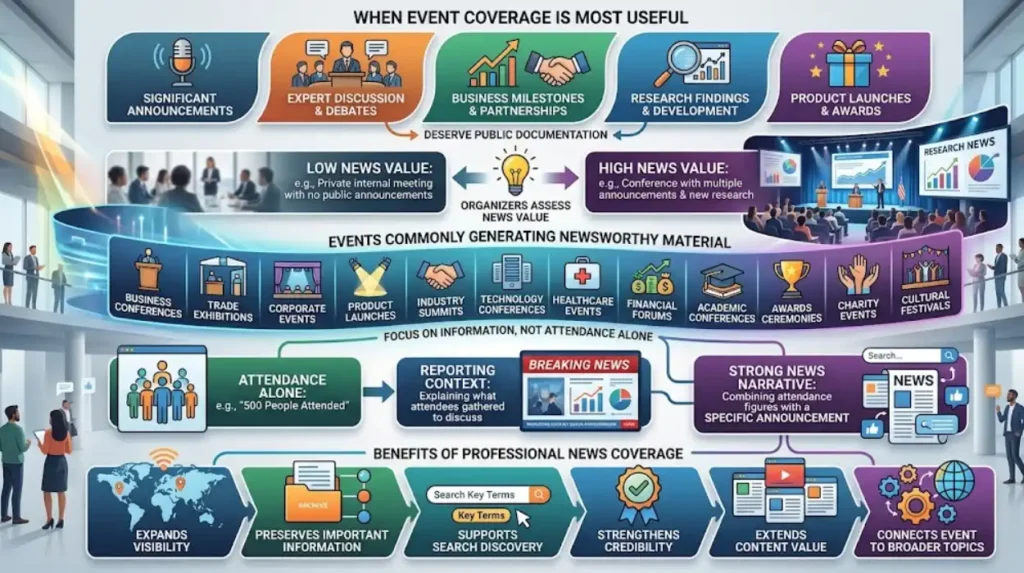
Professional event news coverage is most useful when an event contains a significant announcement, expert discussion, business milestone, research finding, product launch, partnership, award, or development that deserves public documentation beyond the event itself.
Not every event produces the same news value. A private meeting with no public announcement has limited editorial relevance. A conference featuring new research and multiple industry announcements has stronger material for reporting.
Organisers can assess news value before an event by identifying its most important developments.
Which events commonly generate newsworthy material?
Examples include:
- Business conferences
- Trade exhibitions
- Corporate events
- Product launches
- Industry summits
- Technology conferences
- Healthcare events
- Financial forums
- Academic conferences
- Awards ceremonies
- Charity events
- Cultural festivals
The strongest coverage focuses on information rather than attendance alone.
A claim such as “500 people attended” provides a fact. A report explaining what those 500 attendees gathered to discuss provides context. A report combining attendance with a specific announcement creates a stronger news narrative.
Professional news coverage therefore gives an event a documented public presence. It expands visibility, preserves important information, supports search discovery, strengthens credibility, extends content value, and connects event activity with broader topics.
The result is a clearer information trail before, during, and after the event. For organisers, understanding these functions helps you evaluate more detailed event coverage approaches and how publication networks can distribute event stories across multiple audiences. For deeper insight explore: