

Expo news coverage is editorial reporting about a company’s presence, announcement, product, demonstration, speaker, or milestone at an exhibition. It turns event activity into publishable news that extends visibility beyond the physical venue and connects the event with wider UK audiences.
Exhibition news coverage refers to media content generated from an organisation’s participation in an expo, trade show, conference exhibition, or industry showcase. The coverage focuses on information that has genuine news value.
An expo provides a concentrated setting for business activity. Companies launch products, demonstrate technologies, announce partnerships, present research, meet buyers, and discuss industry developments. News coverage records these developments in a format accessible after the event.
The content can include:
- Product announcements
- New technology launches
- Business partnerships
- Executive interviews
- Industry research
- Event demonstrations
- Expansion announcements
- Awards and achievements
- Investment developments
- New market entries
For UK brands, the relevance extends beyond the exhibition venue. A physical event has a limited location and duration. Published news creates a searchable record that remains accessible after the exhibition closes.
How does expo participation become news?
Expo participation becomes news when an event activity contains a clear development, named entity, measurable result, or industry-relevant announcement. Journalistic value comes from the information itself, while the exhibition provides the setting, timing, people, and context required for coverage.
An exhibition presence alone does not define a news story. News value comes from what happens at the exhibition.
A product demonstration becomes more newsworthy when it introduces a new capability. A speaker appearance becomes more relevant when the speaker addresses a significant industry development. A partnership announcement becomes a distinct story when two organisations define a specific commercial relationship.
What information forms the story?
Strong expo stories normally contain several identifiable elements:
- Who — the organisation, executive, speaker, partner, or product owner.
- What — the announcement, launch, demonstration, or development.
- Where — the exhibition, venue, city, or UK region.
- When — the exhibition date or announcement date.
- Why it matters — the commercial, technological, operational, or industry significance.
- Evidence — figures, research, product specifications, quotes, or documented results.
This structure gives journalists a clear factual basis for reporting.
An example is a UK technology company unveiling an energy-monitoring platform at an industrial exhibition in Birmingham. The news story centres on the platform, its capabilities, the company’s announcement, and the relevance to industrial energy management.
What types of content can expo news coverage include?
Expo coverage includes several editorial formats, including event reports, product news, executive interviews, company announcements, technology features, partnership stories, and industry updates. Each format presents exhibition activity through a distinct factual angle for readers and search engines.
The content format depends on the information available at the event.
Product and technology news
Product news focuses on launches, upgrades, specifications, applications, and demonstrations. Technology stories work particularly well when the product addresses a defined industry problem.
For example, an engineering company demonstrating automated inspection equipment can generate coverage focused on inspection speed, operational use, and technical capabilities.
Executive and speaker coverage
Executive coverage focuses on statements from founders, directors, technical leaders, researchers, and other recognised figures.
A chief executive discussing UK manufacturing investment at an exhibition creates a news angle connected to both the event and a wider economic topic.
Partnership announcements
Partnership stories describe agreements between organisations. The strongest examples identify the participants, purpose, market, and expected business activity.
For example, a software company announcing a distribution partnership with a UK retailer provides specific information for an editorial story.
Industry commentary
Industry commentary connects exhibition participation with wider sector developments.
A healthcare technology executive discussing digital diagnostics at a medical exhibition provides context beyond the company itself. The exhibition establishes the setting while the industry issue provides the broader relevance.
What does expo news coverage deliver beyond the exhibition?
Expo news coverage extends the lifespan of an exhibition by converting temporary event activity into permanent digital content. It creates discoverable information, supports brand visibility, documents announcements, and allows audiences outside the venue to access event-related developments.
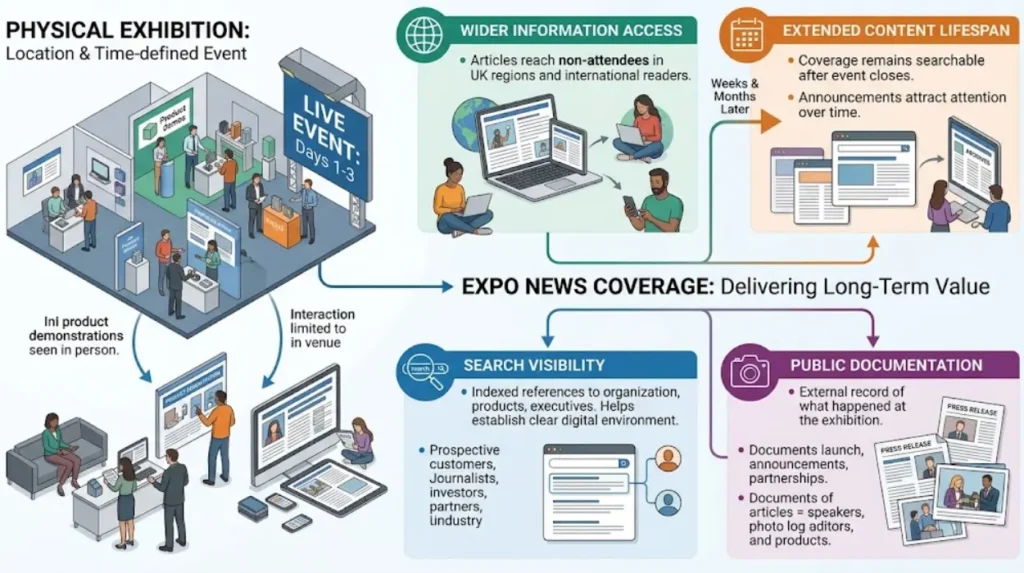
An exhibition normally operates within a defined location and timeframe. News coverage changes the distribution environment.
A visitor at an exhibition can see a product demonstration in person. A published article allows a prospective customer, journalist, investor, partner, or industry professional to discover the same announcement online after the event.
This creates several distinct outcomes.
Wider information access
News articles reach audiences that do not attend the exhibition. This includes people based in different UK regions and international readers researching UK companies or industries.
Extended content lifespan
Event activity ends when the exhibition closes. Digital coverage remains searchable after the event.
An announcement made at an expo can therefore continue attracting attention during the weeks and months following the event.
Search visibility
Published coverage creates additional indexed references to an organisation, executive, product, event, and industry topic.
Search engines use published content to understand entities and relationships. Consistent factual references help establish a clearer digital information environment around the organisation.
Public documentation
Coverage creates an external record of what happened at the exhibition. It documents launches, announcements, partnerships, and executive statements in published form.
How does expo coverage support SEO and AI search visibility?
Expo news coverage supports search visibility by creating relevant pages containing organisation names, product terms, event entities, industry terminology, quotations, and factual relationships. These pages give search systems additional published context about a company and its activities.
Search engine optimisation involves improving the accessibility, relevance, and discoverability of digital content.
Expo coverage contributes through entity-rich information. A single article can connect several entities within one factual context.
For example, coverage about a UK cybersecurity company at an exhibition can mention the company, its security platform, the exhibition, the city, the cybersecurity sector, an executive spokesperson, and a specific product announcement.
These relationships create semantic context.
Which SEO elements matter?
Important elements include:
- Relevant publication pages
- Descriptive headlines
- Named organisations
- Product and service terminology
- Exhibition names
- UK locations
- Industry categories
- Executive names
- Factual quotations
- Supporting statistics
AI-powered search systems also depend on identifiable information. Clear statements and consistent entity references make information easier to interpret and retrieve.
The objective is not simply to repeat keywords. The content needs to explain what happened, who participated, where it happened, and why the development matters.
For organisations developing a broader exhibition content strategy, the next stage explores how expo coverage can turn one physical booth into multiple news stories.
What business benefits can UK brands gain from expo coverage?
UK brands gain several measurable communication benefits from expo coverage, including increased awareness, broader audience access, stronger event visibility, searchable brand references, documented announcements, and additional opportunities for prospects to discover products after the exhibition ends.
The value of expo news coverage extends across the customer journey.
A prospective buyer researching a supplier can encounter an article about its exhibition activity. An existing customer can discover a new product announcement. An industry professional can find commentary from an executive. A journalist can identify a developing story.
Brand awareness
Coverage places the organisation within relevant editorial contexts. The brand appears alongside its industry, event, location, products, and announcements.
Product visibility
A product launched at an exhibition gains a published reference that explains its purpose and features.
For example, a UK construction technology company introducing a digital site-monitoring platform can receive coverage focused on the platform’s application in construction projects.
Credibility through published information
Editorial coverage provides a public information source separate from an organisation’s own website. The article contains factual statements, event context, and potentially third-party editorial presentation.
Post-event discovery
Search behaviour continues after an exhibition. Buyers research suppliers, products, technologies, and industry developments throughout the year.
Published expo coverage gives these searches additional relevant information.
Which UK industries use expo news coverage?
Expo news coverage applies across UK industries where exhibitions support product launches, commercial relationships, demonstrations, research presentations, and industry discussion. Common examples include technology, manufacturing, healthcare, construction, finance, energy, retail, transport, and professional services.
Different industries generate different exhibition news angles.
Technology
Technology exhibitions frequently produce product launches, software demonstrations, artificial intelligence announcements, cybersecurity developments, and digital transformation stories.
Manufacturing
Manufacturing exhibitions focus on machinery, automation, robotics, production systems, materials, and industrial efficiency.
Healthcare
Healthcare exhibitions feature medical technologies, diagnostics, digital health platforms, research developments, and professional discussions.
Construction and property
Construction exhibitions generate stories around building technology, materials, sustainability, infrastructure, property technology, and project innovation.
Finance and fintech
Financial exhibitions often focus on payment technology, banking platforms, compliance technology, investment tools, and financial infrastructure.
Energy
Energy exhibitions provide news angles around renewable technologies, energy efficiency, storage systems, infrastructure, and industrial decarbonisation.
The same principle applies across sectors: the event provides the setting, while the specific development provides the news.
When is expo news coverage most valuable?
Expo news coverage is most valuable when an exhibition includes a new announcement, product launch, partnership, executive statement, research finding, demonstration, or measurable development that remains relevant to audiences after the event has finished.
Timing influences the usefulness of event coverage.
Pre-event information establishes participation and previews announcements. During-event coverage captures launches, demonstrations, interviews, and statements. Post-event coverage documents outcomes and developments that emerged during the exhibition.
Each stage serves a different informational purpose.
Before the exhibition
Pre-event content identifies the organisation, exhibition, location, booth activity, and planned announcements.
During the exhibition
Live event information focuses on launches, demonstrations, presentations, interviews, and announcements.
After the exhibition
Post-event coverage summarises developments, partnerships, product introductions, and industry discussions.
This three-stage approach gives exhibition activity a defined information lifecycle.
How does expo news coverage fit into a wider media strategy?
Expo news coverage forms one part of a broader media strategy by connecting physical events with digital publishing, search visibility, corporate communications, product announcements, executive positioning, and industry storytelling across the customer information journey.
An exhibition does not exist separately from other communication activity.
Product launches can connect with corporate announcements. Executive interviews can support thought leadership. Partnership announcements can connect with commercial development. Research presented at an exhibition can support later industry content.
This creates a structured relationship between event activity and ongoing communication.
The next consideration is distribution. Businesses examining how one exhibition booth can generate multiple published stories can explore:
15 news stories as the next educational step.
For organisations evaluating the media-distribution stage, information about:
Expo news coverage services explains how exhibition announcements can reach multiple UK publication environments.
What should businesses measure after expo news coverage?
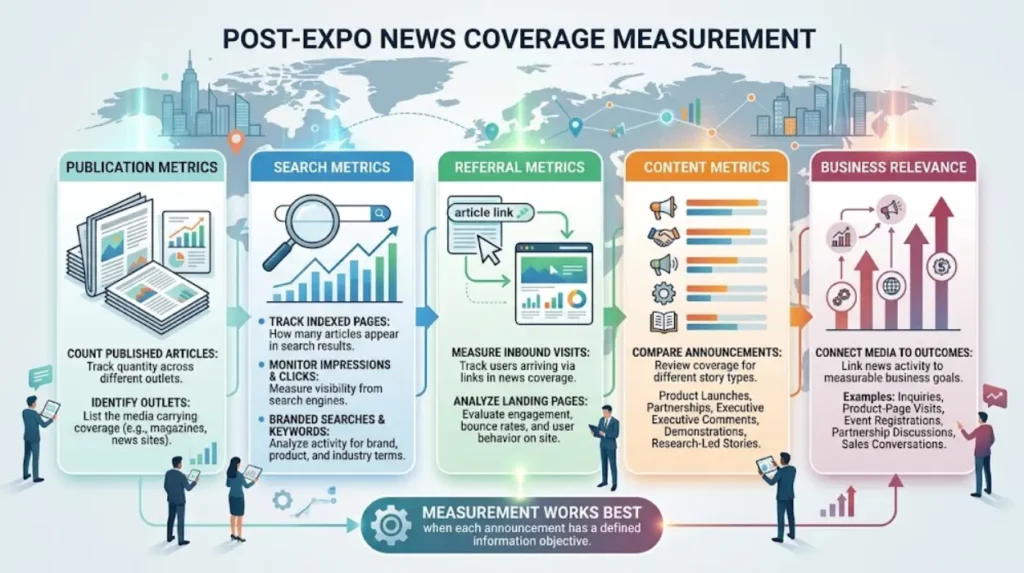
Businesses can measure expo coverage through publication volume, audience reach, indexed pages, referral traffic, branded search activity, engagement, backlinks, message visibility, and the number of relevant references connecting the organisation with its exhibition and industry topics.
Measurement provides evidence of how exhibition activity performs after publication.
Publication metrics
Count the number of published articles and identify the publications carrying the coverage.
Search metrics
Track indexed pages, impressions, clicks, branded searches, and visibility for relevant product and industry terms.
Referral metrics
Measure visits arriving from published articles. Analyse landing pages, engagement, and subsequent website activity.
Content metrics
Review which announcements receive coverage. Compare product launches, partnerships, executive comments, demonstrations, and research-led stories.
Business relevance
Connect media activity with measurable outcomes such as enquiries, product-page visits, event registrations, partnership discussions, or sales conversations.
Measurement works best when each expo announcement has a defined information objective.
Why does expo news coverage matter for UK brands?
Expo news coverage transforms exhibition activity into lasting, searchable information. It extends audience access, documents business developments, strengthens entity visibility, supports search discovery, and connects temporary event participation with continuing digital communication across the UK market.
Exhibitions provide concentrated opportunities for companies to launch products, meet audiences, demonstrate technologies, announce partnerships, and communicate industry developments.
News coverage gives those activities a longer digital lifespan.
Explore More Expert Insights:
How Glasgow Events Secure UK-Wide News Coverage
Why Bristol Events Need Multi-Site News Coverage in 2026
The central value comes from converting event information into structured, factual, discoverable content. A booth exists in one venue for a limited period. A published news story remains available to people researching the organisation, product, executive, industry, or announcement after the exhibition has ended.
For UK businesses, this makes expo news coverage an important part of understanding how physical events generate wider digital visibility.



