Corporate event coverage in the UK involves preparing an event story, selecting relevant media outlets, distributing newsworthy information, and measuring publication results. A structured approach connects one corporate event with national, regional, business, trade, and specialist news audiences.
What does UK corporate event coverage mean?
UK corporate event coverage is the process of turning an event into publishable news and distributing it across selected media outlets. It combines event information, editorial angles, press materials, targeted distribution, publication tracking, and coverage reporting for measurable media visibility.
Corporate event coverage applies to conferences, business launches, awards ceremonies, executive events, industry summits, networking events, product showcases, and corporate milestones.
The central objective is editorial relevance. A corporate event needs a clear reason for media attention. Strong angles include business growth, executive announcements, investment, innovation, employment, industry developments, community impact, and measurable corporate achievements.
The coverage process also depends on the publication category. A national business publication serves a different audience from a regional newspaper or an industry trade journal.
For example, a technology conference in Manchester can generate different stories for a UK technology publication, a Manchester business publication, and a national business news site.
For organisations evaluating media coverage options, the broader concept of:
UK corporate event coverage explains how event stories become part of a structured media distribution strategy.
Which types of corporate events receive media coverage?
Corporate events commonly covered by UK media include:
- Business conferences
- Corporate awards
- Product launches
- Executive appointments
- Industry exhibitions
- Investment announcements
- Company anniversaries
- Charity and community events
- Technology demonstrations
- Business networking events
Each event type requires a relevant news angle. An awards ceremony focuses on winners, business achievements, and industry recognition. A conference focuses on speakers, themes, findings, partnerships, and sector developments.
How does a corporate event move from an announcement to 15 news sites?
A corporate event moves from announcement to publication through five stages: event assessment, story development, media selection, press distribution, and coverage monitoring. Each stage connects the event narrative with suitable UK publications and measurable publication outcomes.
1. Event assessment
The first stage identifies whether the event contains information suitable for editorial coverage.
Key information includes:
- Event name
- Event date
- Location
- Organiser
- Speakers
- Attendees
- Business purpose
- Announcements
- Results
- Supporting statistics
- Quotes
- Images
- Relevant industry context
This information creates the factual foundation of the story.
2. Story development
The event is then converted into a press-ready news story. The headline identifies the central development. The opening paragraph establishes what happened, where it happened, who participated, and why it matters.
A strong corporate event release avoids treating attendance alone as news. It identifies a specific development.
For example, “London technology company hosts annual conference” provides limited news value. “London technology company announces £5 million expansion at annual industry conference” provides a clearer business story.
3. Media selection
The next stage matches the story with appropriate publications.
A 15-site distribution plan can include national business media, regional publications, trade publications, technology media, finance publications, and specialist business outlets.
The selection depends on the event subject and audience.
4. Press distribution
The finished release enters a targeted distribution process. Publication timing matters because the release needs to reach journalists and editorial systems when the event story remains relevant.
For an event held on Thursday, distribution can focus on the announcement before the event and the outcome immediately after it. The timing depends on whether the story concerns attendance, an upcoming announcement, or an event result.
5. Coverage monitoring
Publication monitoring records where the story appears. A coverage report identifies publication names, article URLs, publication dates, headlines, and relevant story details.
This converts media activity into trackable information.
Which 15 news sites are relevant for UK corporate event coverage?
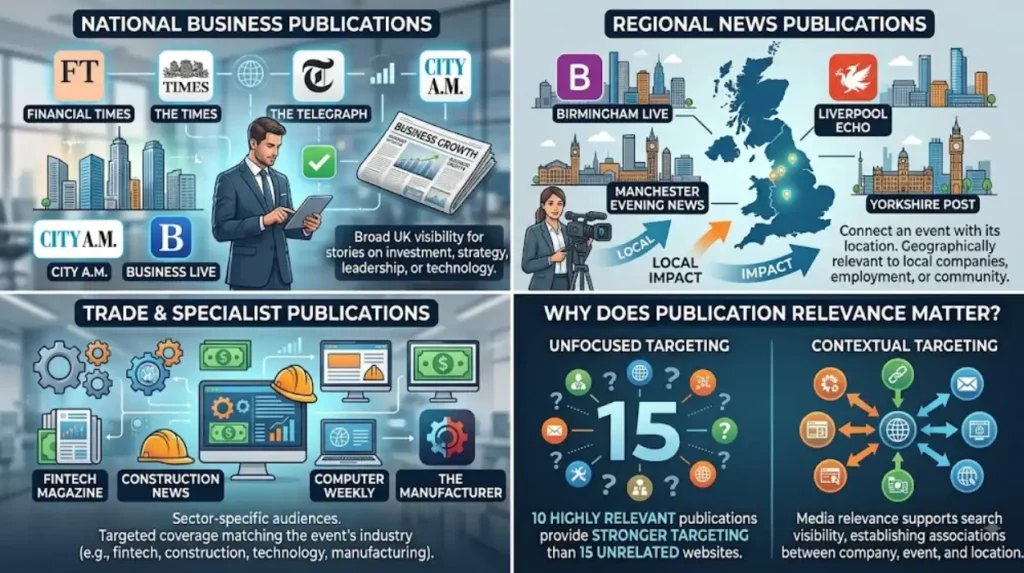
The relevant 15 news sites depend on the event sector, location, audience, and news angle. A balanced distribution list combines national business media, regional publishers, trade publications, specialist sites, and sector-focused outlets matching the announcement.
There is no universal list of 15 publications for every corporate event. Media selection needs to reflect the subject.
National business publications
National business media provide broad UK visibility for stories involving investment, growth, leadership, corporate strategy, employment, technology, or market developments.
Examples include business-focused sections and publications such as Financial Times, The Times, The Telegraph, and City A.M., where editorial relevance and acceptance criteria apply.
Regional news publications
Regional media connect an event with its location.
A Birmingham corporate conference has stronger geographic relevance for Birmingham-focused media than for publications covering unrelated UK regions. Examples include BirminghamLive, Manchester Evening News, Liverpool Echo, and Yorkshire Post.
Regional relevance becomes stronger when the event involves local companies, employment, investment, community activity, or economic development.
Trade and specialist publications
Trade media provide sector-specific audiences.
For example, a fintech conference can target financial technology publications. A construction event can target construction media. A healthcare conference can target healthcare publications.
Relevant outlets can include FinTech Magazine, Construction News, Computer Weekly, and The Manufacturer, depending on the story and editorial requirements.
Why does publication relevance matter?
A 15-site distribution strategy is effective when every publication has a defined audience relationship with the story. Ten highly relevant publications provide stronger contextual targeting than fifteen unrelated websites.
Media relevance also supports search visibility. A corporate event story published on a sector-relevant site establishes clearer associations between the company, event, industry, location, and topic.
What information does a corporate event press release need?
A corporate event press release needs a factual headline, concise introduction, event details, business context, executive quotations, supporting evidence, contact information, and relevant links. These components help editorial teams understand the announcement and determine its publication value.
Headline
The headline states the main news event.
A useful structure identifies the organisation, event, location, or development.
Example:
“Manchester Fintech Firm Announces New Payment Platform at UK Industry Conference”
The headline establishes the company, location, sector, and announcement.
Opening paragraph
The first paragraph answers the core factual questions:
- Who?
- What?
- Where?
- When?
- Why?
This allows readers and editorial teams to understand the story immediately.
Event details
The release identifies the event date, venue, organiser, purpose, speakers, and participating organisations.
Specific details improve factual clarity.
Quotes
Executive or speaker quotes provide attributable commentary. Each quote needs a clear connection to the event and its business significance.
Supporting evidence
Statistics strengthen the story when they directly support the announcement.
Examples include attendance figures, investment amounts, number of businesses represented, survey findings, product adoption figures, or employment data.
Media assets
Relevant photographs, logos, speaker images, event graphics, and video links provide additional publication material.
The assets need accurate captions and clear identification.
How can organisations compare different UK event coverage options?
Organisations can compare event coverage options by evaluating publication relevance, distribution scope, geographic targeting, sector alignment, turnaround time, reporting quality, and measurable outcomes. These criteria distinguish broad media distribution from targeted corporate event coverage programmes.
A structured comparison prevents organisations from evaluating distribution only by the number of websites.
Publication relevance
The first criterion is audience fit. A technology event needs technology and business publications. A regional investment event needs geographic relevance.
Distribution scope
Distribution scope defines how many publications receive the story and what categories they represent.
A 15-site plan can provide a defined media footprint across multiple publication types.
Geographic targeting
UK corporate events often have strong regional relevance. London, Birmingham, Manchester, Leeds, Glasgow, Edinburgh, Bristol, and Cardiff have distinct business media ecosystems.
A regional event strategy connects the story with publications serving the relevant business community.
Sector targeting
Sector targeting improves contextual relevance. Financial services, technology, construction, healthcare, manufacturing, hospitality, retail, and professional services each have specialist media audiences.
Reporting
A professional media coverage report records publication outcomes rather than only distribution activity.
Useful reporting fields include:
- Publication name
- Article headline
- Publication date
- Article URL
- Media category
- Geographic relevance
- Coverage status
This information supports later analysis and internal reporting.
What benefits does coverage across 15 UK news sites provide?
Coverage across 15 relevant UK news sites creates a broader and more structured media footprint for a corporate event. It increases exposure across distinct audiences while producing documented publication results that support communication, search, reputation, and stakeholder reporting.
Wider audience reach
Fifteen relevant publications provide multiple opportunities to reach business readers, industry professionals, regional audiences, investors, customers, and stakeholders.
The audience expands because each publication operates within a different editorial and geographic context.
Stronger brand visibility
Repeated appearances across relevant publications increase the number of locations where an organisation and its event are documented.
The coverage also creates a searchable record of the event.
Search visibility
Published event stories can create indexed references containing company names, executive names, event names, locations, products, and industry terms.
This creates additional third-party content associated with the organisation.
Stakeholder communication
Corporate event coverage provides evidence that an announcement entered external media channels.
Marketing teams can use publication records in campaign reporting. Communications teams can use them in media monitoring. Sales teams can reference relevant coverage where appropriate.
Regional credibility
Regional coverage connects an event with its local business environment.
For example, an Edinburgh corporate event involving Scottish investment, employment, or business development has a stronger regional context when covered by relevant Scottish publications.
When is 15-site UK corporate event coverage most useful?
Fifteen-site coverage is most useful when a corporate event contains a clear news angle and needs visibility across national, regional, business, and specialist audiences. It fits announcements involving launches, investment, leadership, partnerships, awards, and measurable business developments.
Corporate conferences
Conference coverage works when speakers, findings, partnerships, or announcements create a clear news angle.
Product launches
Product launch events provide publication opportunities when the announcement contains specific commercial or technological information.
Corporate awards
Awards coverage focuses on winners, achievement, industry recognition, and measurable performance.
Executive events
Leadership conferences and executive forums can generate coverage when they involve appointments, strategic announcements, investment, or significant industry commentary.
Regional business events
Regional events benefit from geographic targeting. A company opening a new facility in Leeds, for example, has a direct local business story alongside its broader corporate announcement.
Industry exhibitions
Exhibitions can produce multiple news angles involving product launches, partnerships, demonstrations, investment, and sector trends.
Explore More Expert Insights:
Edinburgh Event Coverage: How 15 News Sites Amplify Reach
How Birmingham Event Coverage Gets Published Within 48 Hours
What should organisations measure after corporate event coverage?
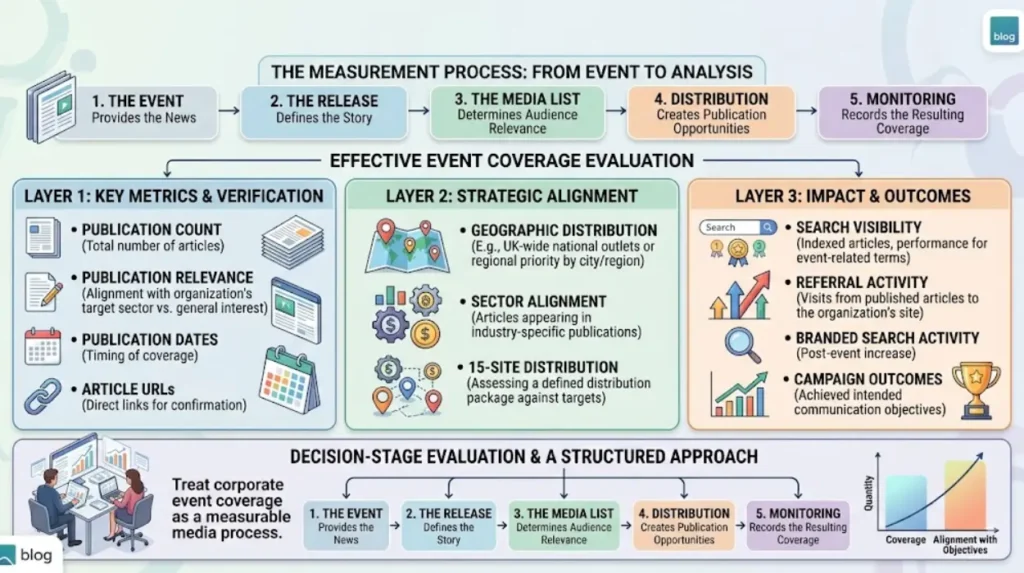
Organisations should measure publication count, publication relevance, geographic distribution, sector alignment, article URLs, publication dates, referral activity, search visibility, and campaign outcomes. These metrics show whether the 15-site distribution achieved its intended communication objectives.
Coverage measurement starts with basic publication verification.
A report confirms whether the intended story appeared and records where it was published.
The next layer evaluates relevance. A publication covering the organisation’s target sector provides different value from an unrelated general-interest site.
Geographic coverage also matters. A UK-wide campaign can include national outlets, while a regional campaign can prioritise publications within a specific city or region.
Search performance provides another measurement layer. Organisations can monitor indexed articles, branded search activity, referral visits, and visibility for event-related terms.
For decision-stage evaluation, organisations can explore:
UK corporate event coverage across 15 news sites to assess how a defined distribution package aligns with publication targets, reporting requirements, and event objectives.
A structured approach therefore treats corporate event coverage as a measurable media process. The event provides the news. The release defines the story. The media list determines audience relevance. Distribution creates publication opportunities. Monitoring records the resulting coverage across the selected UK news sites.