London event coverage across 15 news sites means distributing one event announcement to multiple relevant UK publications through a coordinated media distribution process. The objective is same-day visibility across national, regional, business, lifestyle, and specialist news outlets.
For event organisers, media coverage creates a public record of an event and its key developments. A coordinated distribution strategy places the same core announcement across a defined network of publications.
The 15-site target refers to publication reach rather than 15 identical editorial articles. Each outlet determines how it presents distributed material based on its editorial structure, audience, and publishing process.
A London event release typically contains:
- Event name and location
- Date and time
- Organiser information
- Event purpose
- Speakers or participants
- Key announcements
- Supporting statistics
- Registration information
- Contact details
- Approved images or media assets
For commercial events, conferences, exhibitions, product launches, awards, and corporate announcements, these details give journalists and publication teams structured information for coverage.
The decision-stage question is therefore not simply whether an event can receive publicity. It is whether the distribution process provides sufficient publication reach, speed, relevance, and reporting for the event objective.
How can an event get coverage across 15 London and UK news sites today?
An event can reach 15 London and UK news sites today by preparing a publication-ready press release, selecting an appropriate UK media network, submitting the announcement within its operating window, and monitoring confirmed publication results through structured coverage reporting.
Step 1: Prepare the event announcement
The release needs a clear news angle. The headline identifies the event and its most important development.
The opening paragraph answers the core questions: who, what, where, when, and why.
For example, a London technology conference announcing 500 attendees and 20 industry speakers provides a stronger news structure than a generic statement announcing an upcoming conference.
Step 2: Select the media distribution network
The media network determines where the release is distributed.
A London event can require a combination of:
- UK national publications
- London-focused publications
- Regional news websites
- Business publications
- Technology media
- Finance publications
- Lifestyle outlets
- Industry-specific websites
The selected network needs to match the event audience. A fintech conference requires different publication relevance from a London fashion exhibition or property investment summit.
Step 3: Submit the release
The final release enters the distribution workflow. The service checks formatting, media requirements, publication criteria, and distribution specifications.
A same-day request depends on submission time, editorial processing, publication schedules, and the service’s stated turnaround.
Step 4: Monitor publication results
Coverage monitoring identifies which websites have published the announcement.
A useful report records the publication name, URL, publication date, headline, and relevant coverage details. This turns a distribution activity into measurable media output.
For a deeper explanation of the distribution mechanism, see:
What does a London event press release need before same-day distribution?
A same-day London event press release needs a newsworthy headline, factual opening, verified event details, supporting evidence, contact information, media assets, and publication-ready formatting. Accurate information reduces processing issues and creates consistent coverage across the selected news network.
Newsworthy headline
The headline needs to communicate the main event development immediately.
For example:
“London Fintech Summit Announces 20 Speakers for September Industry Conference”
This provides the event subject, location, category, and significant detail.
Strong opening paragraph
The first paragraph establishes the news value. It avoids lengthy background information.
A useful structure includes the organiser, event, location, date, and principal announcement.
Verified event information
Dates, venues, speaker names, registration details, statistics, and company information need verification before distribution.
Incorrect information creates inconsistencies across publications and complicates post-publication corrections.
Supporting media assets
Images improve the information package when publications accept multimedia content.
Useful assets include event photographs, speaker headshots, venue images, logos, charts, and branded graphics.
Contact details
The release needs a professional media contact. This gives journalists a direct route for clarification, interview requests, or additional information.
How does a 15-site London event distribution service work?
A 15-site event distribution service connects an approved press release with a defined publication network, processes the material, distributes it according to selected criteria, and provides coverage reporting showing where the announcement appeared after publication.
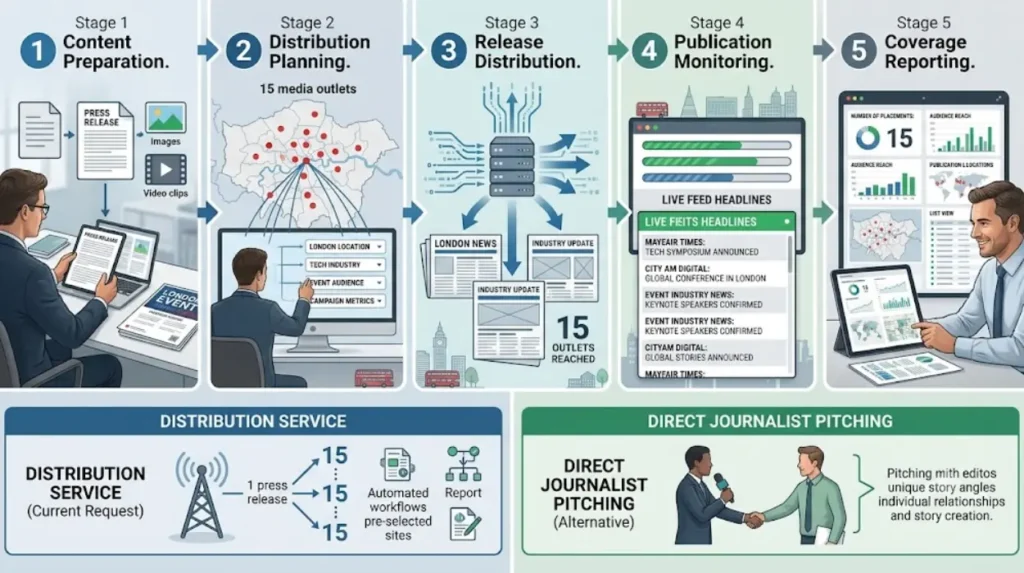
The process generally follows five operational stages.
1. Content preparation
The organiser supplies the final announcement and supporting assets.
2. Distribution planning
The provider identifies the relevant media network based on location, industry, audience, and campaign requirements.
3. Release distribution
The approved material enters the selected distribution network.
4. Publication monitoring
Published URLs are tracked as participating websites post the announcement.
5. Coverage reporting
The organiser receives a report showing the resulting media placements.
This process is different from direct journalist pitching. Distribution focuses on delivering a prepared announcement through a publication network. Journalist outreach involves individual editorial relationships and story pitching.
For an event organiser seeking 15 published sites today, this distinction matters when evaluating service scope and expected deliverables.
What should you check before choosing a service for 15-site coverage?
Before choosing a 15-site event coverage service, verify the publication network, same-day submission rules, guaranteed deliverables, reporting format, content requirements, geographical targeting, industry relevance, and whether the stated 15 sites represent confirmed publication placements.
Publication network
Ask for clarity about the types of publications included.
A network containing 15 relevant UK business and London publications has different value from a network containing unrelated websites.
Same-day conditions
“Today” needs a defined operational meaning.
Check:
- Submission deadline
- Editorial review time
- Distribution start time
- Expected publication period
- Weekend and bank holiday handling
- Correction procedures
Publication guarantee
A service needs to state exactly what it guarantees.
A 15-site distribution guarantee can mean 15 publication placements, while a reach figure refers to potential audience exposure. These are different metrics.
Reporting
Coverage reports need to provide usable evidence.
The minimum useful information includes publication names and live URLs. More detailed reports include publication dates, headlines, campaign identifiers, and coverage metrics.
Relevance
The network needs to match the event.
A London healthcare conference benefits from healthcare and business publications. A property conference benefits from property, construction, finance, and London business media.
What results can you measure from 15 news site coverage?
Results from 15 news site coverage include the number of published articles, publication diversity, live URLs, geographic relevance, referral activity, search visibility, branded mentions, and engagement generated after the event announcement enters the UK media network.
Publication count
The first metric is confirmed publication volume.
If 15 eligible websites publish the release, the campaign achieves its defined placement target.
Geographic coverage
London-focused coverage establishes local relevance. UK-wide publications extend the announcement beyond the capital.
Publication diversity
Coverage across business, technology, finance, lifestyle, and specialist media demonstrates wider topical distribution.
Referral traffic
Live coverage can send visitors to an event registration page, speaker profile, company website, or ticketing platform.
Search visibility
Published coverage creates additional web pages containing the event name, organiser name, speakers, and associated topics.
Search performance depends on indexing, publication quality, competition, and search demand. Publication itself does not guarantee a specific ranking.
Brand visibility
Repeated publication of a consistent event announcement increases the number of online references associated with the organiser and event.
Which London events benefit from 15-site media coverage?
Fifteen-site media coverage fits London conferences, exhibitions, business launches, awards, networking events, product announcements, charity events, property events, technology summits, and industry gatherings that require measurable UK publication visibility on a defined timeline.
Business conferences
Business conferences benefit from coverage that communicates speakers, attendance figures, industry themes, and key announcements.
Product launches
A London product launch can use distributed coverage to announce availability, demonstrations, partnerships, or market entry.
Awards
Awards events generate multiple news angles, including winners, finalists, categories, sponsors, and industry achievements.
Exhibitions
Exhibitions can use coverage to promote dates, venue information, exhibitors, visitor numbers, and featured installations.
Corporate events
Corporate announcements can connect an event with funding, expansion, leadership appointments, partnerships, or strategic developments.
Charity and community events
Charity events require clear information about the organisation, cause, event purpose, location, participation, and fundraising activity.
How can you order London event coverage across 15 news sites today?
To order London event coverage today, provide the final press release, event details, target audience, preferred publication scope, media assets, and required deadline. Confirm the 15-site deliverable, submission cut-off, publication conditions, and reporting before distribution begins.
A decision-ready order needs specific information.
Provide:
- Final press release
- Event date and venue
- Organiser name
- Primary event category
- Target audience
- Approved images
- Website or registration URL
- Media contact
- Required publication scope
- Same-day distribution deadline
The provider then confirms whether the requested 15-site distribution fits the available network and timing.
Before payment or submission, confirm whether the service guarantees publication across 15 sites or provides distribution to a network with publication dependent on individual editorial decisions.
This distinction prevents misunderstanding between distribution reach and confirmed coverage.
For a decision-stage overview of the complete service option, see:
Is 15-site coverage enough for a London event?
Fifteen news sites provide a defined publication target for London event campaigns that need measurable coverage without requiring a large national media programme. The appropriate number depends on event size, audience, sector, geographic scope, timing, and communication objectives.
A 15-site campaign works well when the objective is controlled UK visibility.
A larger event with national importance requires broader distribution. A specialist conference requires stronger industry relevance rather than simply a higher publication count.
The quality and relevance of the publications matter alongside the number of placements.
For example, 15 relevant London and UK business publications can provide stronger contextual visibility for a corporate conference than 30 unrelated websites.
What is the fastest way to turn a London event into measurable media coverage?
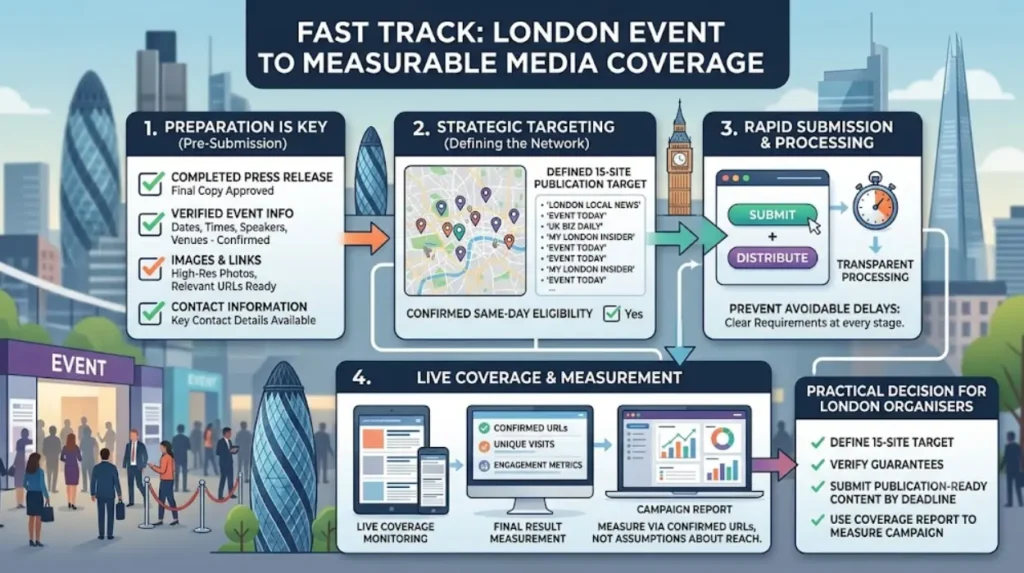
The fastest route is a completed press release, verified event information, a defined 15-site publication target, confirmed same-day eligibility, rapid submission, and live coverage monitoring. Every stage needs clear requirements to prevent avoidable distribution delays.
Same-day event coverage depends on preparation before submission.
The organiser needs final copy, approved facts, images, links, and contact information ready in advance. The distribution provider needs a defined publication network and transparent processing requirements.
The final result needs measurement through confirmed URLs rather than assumptions about reach.
Explore More Expert Insights:
How to Tie Event Media Coverage Directly to Pipeline in Your UK Marketing Report
Why Annual Conferences That Use Managed Coverage See 52% More Delegate Returns
For London event organisers, the practical decision is straightforward: define the 15-site target, verify what the service guarantees, submit publication-ready content within the stated deadline, and use the resulting coverage report to measure the campaign.