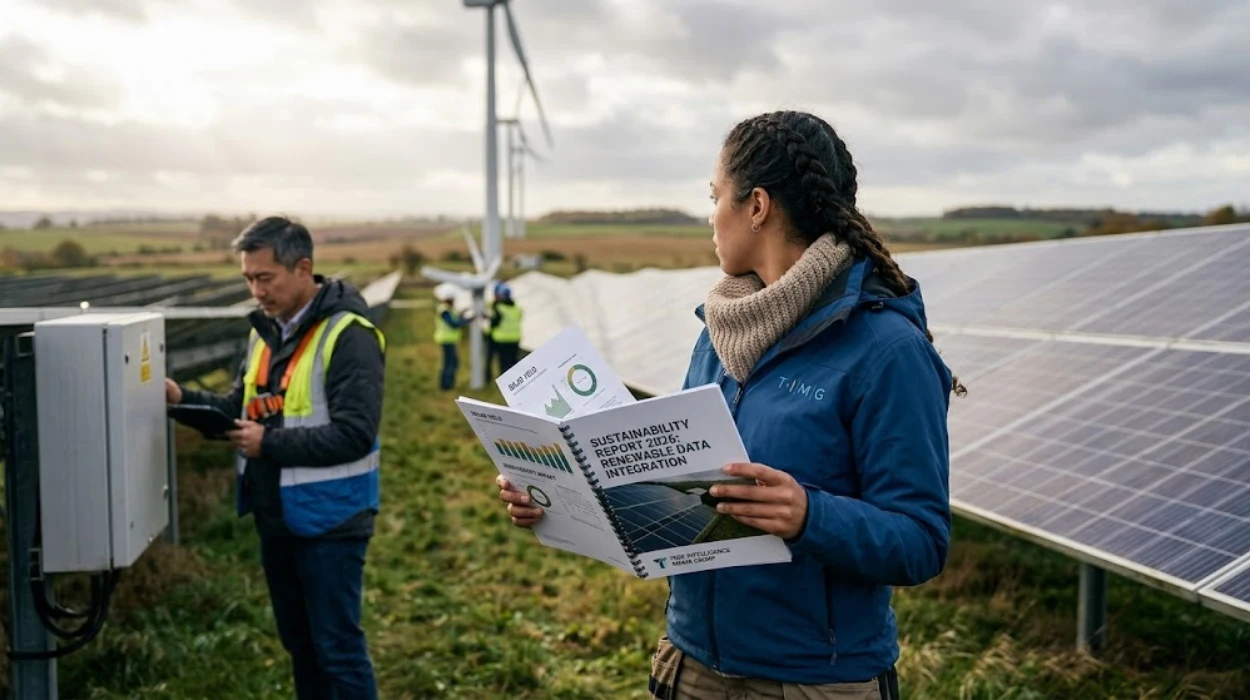
Product launches determine how quickly a new product gains visibility, trust, and customer attention. A standard rollout focuses on publishing product information. A digital media event expands that rollout into a coordinated campaign that attracts journalists, industry publications, search engines, retail media platforms, influencers, and customers across multiple channels. This structured approach increases media exposure, strengthens brand authority, and extends the lifespan of launch content.
What turns a standard product rollout into a major digital media event?
A major digital media event combines strategic timing, newsworthy storytelling, multi-channel distribution, media outreach, search optimisation, and performance measurement into one coordinated launch programme that creates sustained visibility instead of a single announcement while generating measurable engagement across multiple digital platforms simultaneously.
A standard product rollout often includes a product page, a press release, and social media updates. A digital media event expands these activities into a structured communications strategy.
A digital media event is a planned marketing and public relations campaign that delivers one consistent message through multiple digital channels during a defined launch period.
The primary objectives include:
- Generate widespread media coverage.
- Increase qualified website traffic.
- Improve organic search visibility.
- Build authoritative backlinks.
- Drive product enquiries and sales.
- Strengthen brand credibility.
For example, a UK electronics retailer launching a smart home device distributes a press release, publishes expert interviews, provides product demonstrations to journalists, collaborates with technology reviewers, creates educational videos, and publishes customer-focused buying guides during launch week.
This coordinated activity creates multiple opportunities for discovery instead of relying on one announcement.
Why does planning begin several weeks before launch?
Successful digital media events rely on structured preparation completed before launch day because editorial calendars, creative assets, search optimisation, media relationships, technical testing, and promotional schedules require coordinated execution across every communication channel before public announcements begin.
Preparation generally begins between six and eight weeks before launch.
Define launch objectives
Each campaign starts with measurable objectives.
Examples include:
- 100 media mentions
- 50 high-authority backlinks
- 30,000 product page visits
- 2,500 qualified leads
- 8% conversion rate
Clear objectives determine campaign priorities.
Identify target audiences
Different audiences require different messaging.
Typical audiences include:
- Consumers
- Retail buyers
- Industry journalists
- Business publications
- Influencers
- Existing customers
- Investors
Each audience receives content aligned with its interests.
Prepare campaign assets
Essential assets include:
- Product photography
- Demonstration videos
- Press kits
- Product specifications
- Executive biographies
- Customer case studies
- Frequently asked questions
- Landing pages
Complete assets improve consistency across all publications.
How do you create a newsworthy product story?
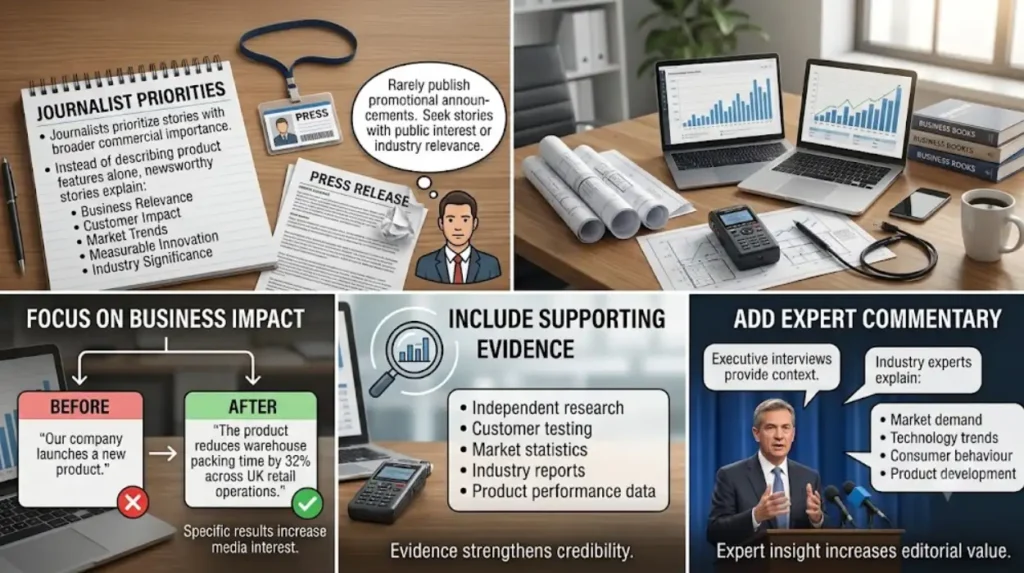
A product story becomes newsworthy when it explains business relevance, customer impact, market trends, measurable innovation, or industry significance instead of describing product features alone because journalists prioritise stories with broader commercial importance.
Journalists rarely publish promotional announcements.
They publish stories with public interest or industry relevance.
Focus on business impact
Instead of writing:
“Our company launches a new product.”
Present:
“The product reduces warehouse packing time by 32% across UK retail operations.”
Specific results increase media interest.
Include supporting evidence
Supporting evidence includes:
- Independent research
- Customer testing
- Market statistics
- Industry reports
- Product performance data
Evidence strengthens credibility.
Add expert commentary
Executive interviews provide context.
Industry experts explain:
- Market demand
- Technology trends
- Consumer behaviour
- Product development
Expert insight increases editorial value.
Which digital channels create the strongest launch impact?
High-performing product launches combine owned, earned, shared, and paid media because each communication channel reaches different audiences while reinforcing consistent messaging throughout the launch period and extending campaign visibility beyond publication day.
No single channel reaches every audience.
Integrated campaigns maximise exposure.
Owned media
Owned media includes:
- Company websites
- Product pages
- Blogs
- Email newsletters
- Knowledge centres
These channels remain under direct organisational control.
Earned media
Earned media includes:
- News websites
- Trade publications
- Industry magazines
- Retail media publications
- Editorial interviews
Earned coverage strengthens authority.
Shared media
Shared media includes:
- X
- YouTube
Each platform supports audience engagement.
Paid promotion
Paid promotion includes:
- Search advertising
- Sponsored articles
- Retail media advertising
- Native advertising
- Social advertising
Paid campaigns amplify organic reach.
How does search optimisation improve launch visibility?
Search optimisation improves launch performance by making every campaign asset understandable for search engines, AI systems, and readers while increasing discoverability through structured content, relevant keywords, and authoritative backlinks generated during media coverage.
Search visibility begins before launch.
Each asset supports search performance.
Optimise launch pages
Landing pages include:
- Primary keyword
- Semantic keywords
- Product specifications
- Frequently asked questions
- Structured headings
- Internal links
These elements improve indexing.
Build authoritative backlinks
Editorial coverage generates backlinks.
High-authority retail publications strengthen domain authority.
Brands interested in understanding backlink value can review:
High-Authority Backlinks from Retail Media
Create supporting content
Supporting content includes:
- Buying guides
- Product comparisons
- Tutorial articles
- Customer success stories
Each article expands search visibility.
What role does media outreach play during product launches?
Media outreach connects product announcements with relevant journalists, editors, industry analysts, influencers, and publication networks through personalised communication that aligns each story with editorial interests and publication audiences rather than mass distribution alone.
Effective outreach depends on relevance.
Generic media lists reduce response rates.
Build targeted media lists
Separate lists include:
- National newspapers
- Technology publications
- Retail publications
- Regional business media
- Trade journals
Each group receives customised pitches.
Personalise media communication
Editors expect concise information.
Effective pitches contain:
- News angle
- Supporting statistics
- Interview availability
- Product images
- Launch timing
Personalisation improves coverage opportunities.
Schedule follow-up activity
Professional follow-up includes:
- Additional product information
- Interview coordination
- Image requests
- Review unit delivery
Consistent communication strengthens relationships.
How do supporting campaigns extend launch momentum?
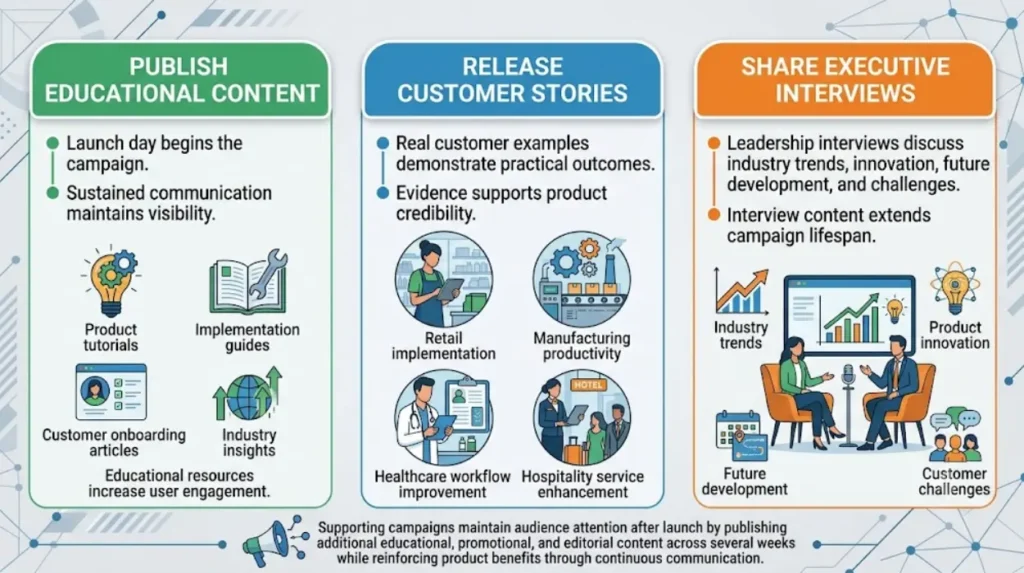
Supporting campaigns maintain audience attention after launch by publishing additional educational, promotional, and editorial content across several weeks while reinforcing product benefits through continuous communication instead of relying upon one publication date.
Launch day begins the campaign.
Sustained communication maintains visibility.
Publish educational content
Examples include:
- Product tutorials
- Implementation guides
- Customer onboarding articles
- Industry insights
Educational resources increase user engagement.
Release customer stories
Real customer examples demonstrate practical outcomes.
Examples include:
- Retail implementation
- Manufacturing productivity
- Healthcare workflow improvement
- Hospitality service enhancement
Evidence supports product credibility.
Share executive interviews
Leadership interviews discuss:
- Industry trends
- Product innovation
- Future development
- Customer challenges
Interview content extends campaign lifespan.
Which metrics measure the success of a digital media event?
Campaign performance measurement combines media exposure, audience engagement, search visibility, website behaviour, lead generation, and revenue attribution into measurable indicators that demonstrate commercial outcomes from coordinated product launch activities across every communication channel.
Performance measurement begins before launch.
Baseline metrics allow accurate comparison.
Media performance metrics
Examples include:
- Media mentions
- Publication reach
- Editorial placements
- Journalist responses
- Backlink quantity
These metrics evaluate publicity.
Digital marketing metrics
Common indicators include:
- Organic traffic
- Referral traffic
- Click-through rate
- Average engagement time
- Landing page conversions
These metrics measure user behaviour.
Commercial metrics
Business outcomes include:
- Product enquiries
- Sales revenue
- Customer acquisition cost
- Return on investment
- Customer lifetime value
Commercial metrics demonstrate financial impact.
Organisations evaluating campaign effectiveness can compare outcomes with:
How can organisations build a repeatable digital launch framework?
Repeatable launch frameworks document planning processes, communication schedules, asset production, approval workflows, distribution methods, measurement systems, and post-launch reviews so future product introductions become faster, more consistent, and increasingly effective across every campaign.
Documenting successful processes improves future launches.
Each campaign contributes measurable insights.
Essential framework components include:
- Campaign timelines
- Editorial calendars
- Media contact databases
- Content production workflows
- Distribution checklists
- Performance dashboards
- Post-launch reporting
Post-launch reviews identify strengths and improvement opportunities.
Continuous refinement increases efficiency and campaign quality over time.
A repeatable framework also supports consistency across multiple product launches throughout the year. Marketing teams, communications specialists, product managers, and external partners operate from one coordinated plan. This alignment reduces delays, improves message consistency, and strengthens overall campaign execution.
Explore More Expert Insights:
The Online Retailer’s Guide to Crafting High-Conversion Pitches for Holiday Gift Guides
Integrating Compliant Press Distribution into Your National Financial Rollout Strategy
A standard product rollout informs the market that a product exists. A major digital media event creates sustained attention before, during, and after launch. Structured planning, newsworthy storytelling, coordinated channel selection, search optimisation, targeted media outreach, and continuous performance measurement transform a routine announcement into a comprehensive digital campaign.
For organisations operating in competitive UK markets, this blueprint establishes a systematic process for improving media visibility, increasing authoritative backlinks, strengthening search performance, and delivering measurable commercial outcomes through every product launch.