
Software companies build trust and credibility by demonstrating product quality, security, transparency, expertise, and consistent customer value. In competitive markets, buyers compare multiple providers before making purchasing decisions. Trust reduces uncertainty and helps businesses establish long-term relationships with customers, partners, and investors.
Why do software companies need trust and credibility in competitive niches?
Trust and credibility influence purchasing decisions, customer retention, business partnerships, and market reputation. Buyers compare products using evidence instead of marketing claims. Companies with transparent operations, verified performance, and consistent communication earn stronger confidence throughout the software buying process.
Highly competitive software markets contain hundreds or thousands of products solving similar business problems. Examples include customer relationship management (CRM) software, cybersecurity platforms, project management tools, and accounting applications.
Trust is the belief that a company delivers what it promises. Credibility is the perception that the company’s claims are supported by reliable evidence.
A trusted software company demonstrates:
- Stable product performance
- Clear product documentation
- Transparent pricing
- Reliable customer support
- Consistent product updates
Buyers often research several sources before selecting software. They review product documentation, security certifications, customer reviews, technical blogs, analyst reports, and company announcements.
Companies with stronger credibility reduce buyer uncertainty during evaluation.
What factors influence trust in software companies?
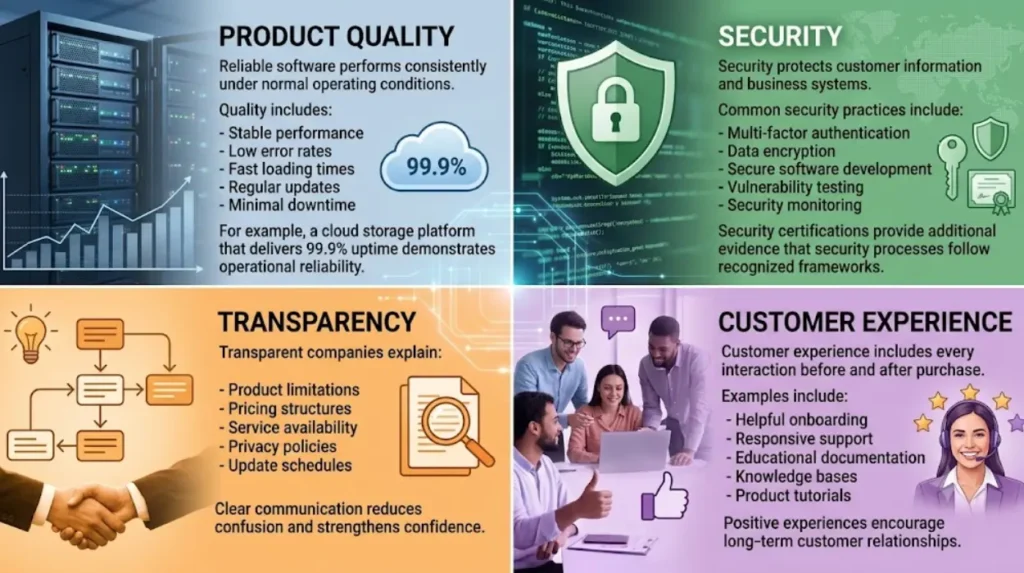
Trust develops through measurable business practices, transparent communication, product reliability, verified customer experiences, and compliance with recognised standards. Each factor contributes evidence that supports confidence in the company, its products, and its long-term commitment to customers.
Product quality
Reliable software performs consistently under normal operating conditions.
Quality includes:
- Stable performance
- Low error rates
- Fast loading times
- Regular updates
- Minimal downtime
For example, a cloud storage platform that delivers 99.9% uptime demonstrates operational reliability.
Security
Security protects customer information and business systems.
Common security practices include:
- Multi-factor authentication
- Data encryption
- Secure software development
- Vulnerability testing
- Security monitoring
Security certifications provide additional evidence that security processes follow recognised frameworks.
Transparency
Transparent companies explain:
- Product limitations
- Pricing structures
- Service availability
- Privacy policies
- Update schedules
Clear communication reduces confusion and strengthens confidence.
Customer experience
Customer experience includes every interaction before and after purchase.
Examples include:
- Helpful onboarding
- Responsive support
- Educational documentation
- Knowledge bases
- Product tutorials
Positive experiences encourage long-term customer relationships.
How does product quality strengthen credibility?
High product quality demonstrates operational competence through consistent performance, dependable functionality, regular maintenance, and verified customer satisfaction. Buyers rely on observable product behaviour because measurable performance provides stronger evidence than promotional statements or advertising messages.
Software quality becomes visible through daily usage.
Important quality indicators include:
Reliable functionality
Features perform exactly as documented.
For example, accounting software generates financial reports accurately without calculation errors.
Frequent updates
Regular updates improve performance, fix defects, and introduce new capabilities.
Consistent development activity signals ongoing investment.
Performance monitoring
Companies monitor:
- Server uptime
- Response times
- System availability
- Error rates
Publishing service status information increases transparency.
Quality assurance
Quality assurance is the structured process of testing software before release.
Testing includes:
- Functional testing
- Performance testing
- Security testing
- Compatibility testing
- User acceptance testing
Comprehensive testing reduces defects reaching customers.
How do transparency and communication improve trust?
Transparent communication provides accurate information about products, business operations, pricing, updates, and limitations. Honest communication establishes realistic expectations and reduces misunderstandings that weaken customer confidence during software evaluation and long-term product usage.
Transparency begins before customers purchase software.
Clear pricing
Pricing pages explain:
- Subscription levels
- Included features
- Additional costs
- Billing frequency
- Cancellation policies
Hidden charges reduce credibility.
Honest documentation
Documentation explains both strengths and limitations.
Examples include:
- Supported operating systems
- Integration requirements
- Technical limitations
- Storage limits
Accurate documentation improves customer expectations.
Public product updates
Release notes document:
- New features
- Bug fixes
- Security improvements
- Performance enhancements
Visible development activity demonstrates continuous improvement.
Why are customer reviews and case studies important?
Customer reviews and case studies provide independent evidence of software performance through real-world experiences. Buyers compare verified customer outcomes because practical examples support credibility more effectively than company-generated promotional content or advertising messages.
Customer feedback contributes social proof.
Customer reviews
Review platforms collect feedback from verified users.
Reviews often discuss:
- Ease of use
- Customer support
- Product reliability
- Feature quality
- Return on investment
Multiple consistent reviews strengthen confidence.
Case studies
Case studies describe measurable business outcomes.
Examples include:
- Reduced processing time
- Lower operational costs
- Faster project completion
- Improved customer response times
Specific metrics increase credibility.
Testimonials
Testimonials highlight customer satisfaction using authentic experiences.
Named organisations and identifiable job roles increase authenticity.
How do industry certifications and compliance support credibility?
Industry certifications demonstrate that independent organisations evaluated specific business processes, security controls, or quality management systems. Compliance with recognised standards provides objective evidence that supports customer confidence during software evaluation and procurement decisions.
Certifications establish recognised benchmarks.
Examples include:
- ISO 27001 for information security management
- SOC 2 for operational controls
- GDPR compliance for personal data protection
- Cyber Essentials certification within the United Kingdom
Independent assessments strengthen business credibility.
Compliance documentation also supports enterprise procurement processes.
Many organisations require vendors to demonstrate compliance before contracts are approved.
How does thought leadership increase industry trust?
Thought leadership builds credibility by sharing accurate knowledge, research findings, technical expertise, and educational content. Consistent publication of useful information demonstrates subject expertise and helps software companies establish authority within specialised technology markets.
Thought leadership focuses on education instead of promotion.
Examples include:
- Technical articles
- Industry research reports
- Product engineering blogs
- Security analysis
- Software development best practices
Educational content helps buyers understand industry challenges.
Public speaking at conferences and contributing technical documentation also strengthen professional reputation.
What role does customer support play in building credibility?
Customer support strengthens trust by resolving problems efficiently, providing accurate technical guidance, and maintaining consistent communication. Reliable support demonstrates operational capability throughout the customer relationship instead of only during product acquisition.
Support quality directly affects customer satisfaction.
Important support elements include:
Fast response times
Customers expect prompt acknowledgement of support requests.
Published response targets improve transparency.
Knowledge resources
Examples include:
- Help centres
- Documentation libraries
- Frequently asked questions
- Video tutorials
Self-service resources improve customer experience.
Consistent issue resolution
Support teams document problems and provide accurate solutions.
Repeated issue resolution improves customer confidence.
How can software companies demonstrate expertise before customers buy?
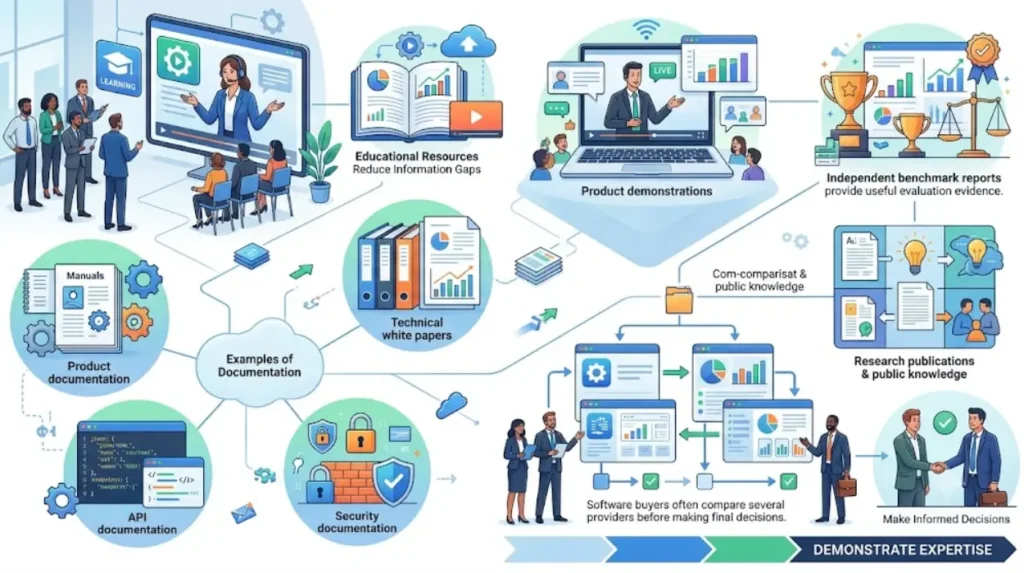
Software companies demonstrate expertise through educational resources, transparent documentation, technical demonstrations, product comparisons, research publications, and publicly available knowledge. Educational evidence helps buyers evaluate competence before making purchasing decisions.
Educational resources reduce information gaps.
Examples include:
- Product documentation
- Technical white papers
- API documentation
- Security documentation
- Product demonstrations
Independent benchmark reports also provide useful evaluation evidence.
Software buyers often compare several providers before making final decisions.
Understanding media resources also supports credibility planning. Businesses preparing product announcements can explore:
Creating a Digital Press Kit to understand how structured media assets improve communication consistency.
What common mistakes reduce software company credibility?
Credibility declines when companies provide inaccurate information, inconsistent communication, poor customer experiences, unclear pricing, weak security practices, or unsupported marketing claims. Buyers recognise inconsistencies quickly because information remains accessible across multiple digital channels.
Several common mistakes damage trust.
Exaggerated product claims
Unsupported performance claims reduce credibility.
Companies benefit from publishing measurable evidence instead.
Poor communication
Delayed responses, missing documentation, and unclear product updates create uncertainty.
Regular communication improves transparency.
Hidden pricing
Unexpected charges reduce customer confidence.
Complete pricing information supports informed purchasing decisions.
Inconsistent branding
Different product descriptions across websites, documentation, and marketing materials create confusion.
Consistency improves reliability.
Ignoring customer feedback
Addressing customer feedback demonstrates continuous improvement.
Visible updates based on user input strengthen trust.
Explore More Expert Insights:
The Role of PR in Accelerating Growth and Valuation After a Seed Round
What is Tech Thought Leadership in the AI Era and Why Does It Matter?
How does trust contribute to long-term business success?
Trust supports customer retention, stronger referrals, improved partnerships, sustainable revenue growth, and positive market reputation. Credibility develops gradually through consistent operational performance, transparent communication, and verified customer satisfaction across every stage of the software lifecycle.
Trust creates measurable business outcomes.
Customers often renew subscriptions when software consistently delivers expected value.
Satisfied customers recommend products to colleagues and professional networks.
Business partners prefer reliable organisations with transparent operations.
Investors also evaluate credibility through product quality, governance, customer growth, and operational consistency.
As software companies mature, structured communication becomes increasingly important. Businesses evaluating announcement strategies can later explore:
PR Distribution Pricing Guide to understand how distribution options differ during product growth stages.
Building trust and credibility in highly competitive software niches depends on consistent evidence rather than marketing claims. Product quality, security, transparency, customer experience, verified reviews, recognised certifications, educational content, and responsive support all contribute to stronger business reputation.
Software buyers increasingly evaluate companies through publicly available information before making purchasing decisions. Clear documentation, measurable performance, independent validation, and honest communication reduce uncertainty throughout the evaluation process. Organisations that consistently demonstrate these characteristics establish lasting credibility, strengthen customer confidence, and create durable competitive advantages in crowded software markets.