
Enterprise technology companies rely on public relations distribution to deliver announcements to journalists, analysts, investors, partners, and industry audiences. The decision between custom managed PR distribution services and self-service tool stacks directly affects campaign execution, media reach, reporting quality, and internal resource requirements. Understanding the differences helps organisations select a solution that aligns with business objectives, compliance requirements, and communication scale.
What is enterprise tech PR distribution?
Enterprise technology PR distribution is the structured process of delivering corporate news to targeted media outlets, industry publications, journalists, analysts, and digital channels using managed services or software platforms. It supports consistent communication, measurable visibility, and controlled campaign execution across multiple markets.
Enterprise tech PR distribution differs from standard press release publishing because enterprise organisations manage larger audiences, multiple stakeholders, regulated information, and higher publication volumes.
Examples include:
- Product launch announcements
- Artificial intelligence platform updates
- Enterprise software releases
- Cybersecurity reports
- Funding announcements
- Executive appointments
- Annual research findings
Distribution extends beyond publishing a press release. It includes audience targeting, editorial review, media selection, scheduling, reporting, compliance checks, and performance measurement.
Companies evaluating distribution models often begin by understanding:
Tech Thought Leadership in the AI Era.
What are custom managed PR distribution services?
Custom managed PR distribution services provide dedicated specialists who plan, review, distribute, monitor, and report enterprise news campaigns using professional media relationships, editorial expertise, and tailored distribution strategies designed for business objectives.
A managed service combines technology with experienced communications professionals.
What does a managed service include?
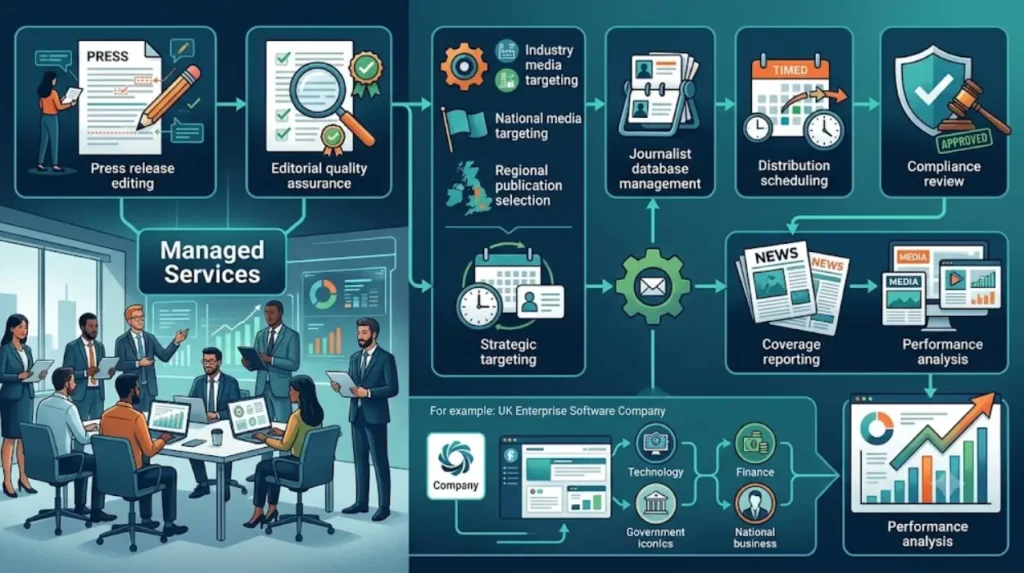
Typical enterprise managed services include:
- Press release editing
- Editorial quality assurance
- Industry media targeting
- National media targeting
- Regional publication selection
- Journalist database management
- Distribution scheduling
- Compliance review
- Coverage reporting
- Performance analysis
For example, a UK enterprise software company launching a cybersecurity platform receives tailored media lists covering technology, financial services, government IT, and national business publications instead of relying on generic distribution.
Why do enterprises choose managed services?
Large organisations value consistency.
A managed provider coordinates every stage of distribution while internal marketing and communications teams focus on strategy, executive messaging, and stakeholder engagement.
Managed services also reduce operational delays during high-priority announcements.
What are self-service PR tool stacks?
Self-service PR tool stacks are software platforms that allow organisations to create, upload, distribute, and monitor press releases independently without dedicated campaign management or editorial support from communications specialists.
The customer controls every stage of the campaign.
The platform typically provides:
- Press release templates
- Media databases
- Distribution options
- Contact management
- Campaign dashboards
- Basic reporting
- Email distribution
- Analytics
How do self-service platforms operate?
The communications team prepares the announcement internally.
Users select target industries, upload content, schedule publication, and monitor campaign metrics through an online dashboard.
The organisation remains responsible for:
- Content accuracy
- Media list quality
- Timing decisions
- Journalist targeting
- Follow-up communication
- Reporting interpretation
Self-service software prioritises operational independence rather than strategic support.
How do managed services compare with self-service tool stacks?
Managed services deliver expert guidance, customised targeting, and operational support, while self-service tool stacks prioritise automation, internal control, and lower operational involvement from external communications specialists throughout campaign execution.
Both approaches distribute news.
Their operational models differ significantly.
Editorial quality
Managed services include professional review before distribution.
Self-service platforms depend entirely on internal content quality.
Media targeting
Managed services build tailored media lists based on announcement relevance.
Self-service platforms rely on customer-selected contacts.
Campaign execution
Managed providers coordinate scheduling, publication timing, and distribution.
Self-service software automates publishing after user configuration.
Reporting
Managed services deliver interpreted performance reports with actionable insights.
Self-service dashboards present raw metrics that internal teams analyse independently.
Internal workload
Managed services reduce workload.
Self-service platforms require internal teams to manage every operational step.
Which solution delivers stronger media targeting?
Custom managed services deliver more precise media targeting because specialists classify industries, publication relevance, journalist interests, and editorial priorities before distributing enterprise announcements to carefully selected recipients.
Media relevance determines campaign quality.
Sending one announcement to thousands of unrelated journalists reduces engagement.
Managed targeting process
Professional distribution teams evaluate:
- Industry sector
- Company size
- Geographic market
- Audience interest
- Editorial relevance
- Previous publication history
For example, an enterprise cloud computing announcement reaches enterprise IT publications, cloud infrastructure editors, data centre publications, technology analysts, and business media.
Self-service targeting process
Software platforms provide searchable journalist databases.
Internal teams select contacts manually.
Campaign quality depends on user experience and database management.
How do reporting and analytics differ?
Managed services provide structured reporting with expert interpretation, while self-service platforms present dashboard metrics that internal teams evaluate independently using available campaign performance data.
Reporting supports future communication planning.
Enterprise organisations require measurable outcomes.
Managed reporting includes
- Publication lists
- Media pickup
- Geographic reach
- Audience estimates
- Industry coverage
- Campaign summary
- Strategic recommendations
Self-service reporting includes
- Email delivery
- Open rates
- Link clicks
- Publication counts
- Dashboard statistics
- Basic analytics
Enterprise leadership often requires executive-ready reporting rather than raw data exports.
Which option supports regulated enterprise communications?
Managed PR distribution services support regulated communications through editorial review, approval workflows, compliance verification, and coordinated release management before public distribution across selected media channels.
Many enterprise sectors operate under regulatory obligations.
Examples include:
- Financial technology
- Healthcare technology
- Cybersecurity
- Defence technology
- Public infrastructure
- Government suppliers
Managed specialists review announcements before publication.
This process reduces factual inconsistencies and publication errors.
Self-service platforms depend on internal governance procedures.
Compliance responsibility remains entirely with the organisation.
How do costs compare between both approaches?
Self-service platforms typically involve lower software subscription costs, while managed services include additional operational expertise, campaign management, strategic planning, and reporting capabilities that increase overall service value.
Software pricing focuses on platform access.
Managed services combine technology with professional execution.
Cost comparisons involve more than subscription fees.
Organisations also evaluate:
- Internal staffing
- Campaign complexity
- Publication frequency
- Executive involvement
- Approval workflows
- Reporting requirements
A lower platform cost does not automatically reduce total communication costs if internal teams spend significant time managing campaigns.
Which organisations benefit most from managed services?
Managed PR distribution services suit enterprises requiring strategic communications, executive oversight, regulatory compliance, multi-market campaigns, and comprehensive reporting supported by experienced communications professionals.
Managed services fit organisations with complex communication environments.
Examples include:
- Enterprise software companies
- Artificial intelligence vendors
- Cloud infrastructure providers
- Telecommunications companies
- Public technology firms
- International SaaS providers
These organisations publish announcements involving investors, regulators, journalists, customers, and partners.
Coordinated campaign management improves operational consistency.
Companies planning research-driven announcements often strengthen future campaigns through:
Internal Product Data into a Viral Tech Industry Report.
Which organisations benefit most from self-service platforms?
Self-service PR platforms suit organisations with experienced internal communications teams, established editorial processes, predictable announcement schedules, and sufficient resources to manage distribution independently.
Internal communications departments often develop repeatable publishing processes.
Software platforms support these workflows efficiently.
Typical users include:
- Technology companies with dedicated PR teams
- Large marketing departments
- Corporate communications teams
- Organisations publishing frequent operational updates
Self-service platforms provide flexibility when internal expertise already exists.
How should enterprise organisations choose between managed services and self-service tool stacks?
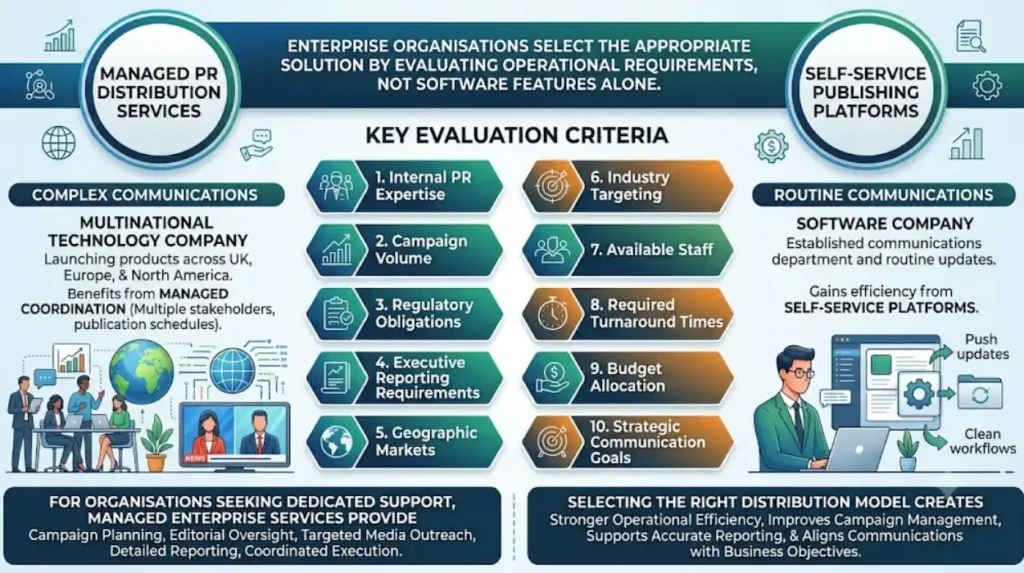
Enterprise organisations select the appropriate solution by evaluating communication complexity, available internal expertise, reporting expectations, compliance obligations, campaign scale, and long-term business objectives before investing in distribution capabilities.
Decision-making involves operational requirements rather than software features alone.
Key evaluation criteria include:
- Internal PR expertise
- Campaign volume
- Regulatory obligations
- Executive reporting requirements
- Geographic markets
- Industry targeting
- Available staff
- Required turnaround times
- Budget allocation
- Strategic communication goals
A multinational technology company launching products across the United Kingdom, Europe, and North America often benefits from managed coordination because campaigns involve multiple stakeholders and publication schedules.
Explore More Expert Insights:
ROI Case Study: How a Bootstrap SaaS Grew Domain Rating from 10 to 50 via Newswire PR
Top 5 PR Distribution Services for SaaS Series A Funding Announcements Compared
A software company with an established communications department and routine product updates often gains efficiency from self-service publishing platforms.
For organisations seeking dedicated support, managed enterprise PR distribution services provide campaign planning, editorial oversight, targeted media outreach, detailed reporting, and coordinated execution. These capabilities simplify complex communications while maintaining consistency across every announcement.
Selecting the right distribution model creates stronger operational efficiency, improves campaign management, supports accurate reporting, and aligns enterprise communications with measurable business objectives.